
Why Pay Attention to Agent Loop Design Now
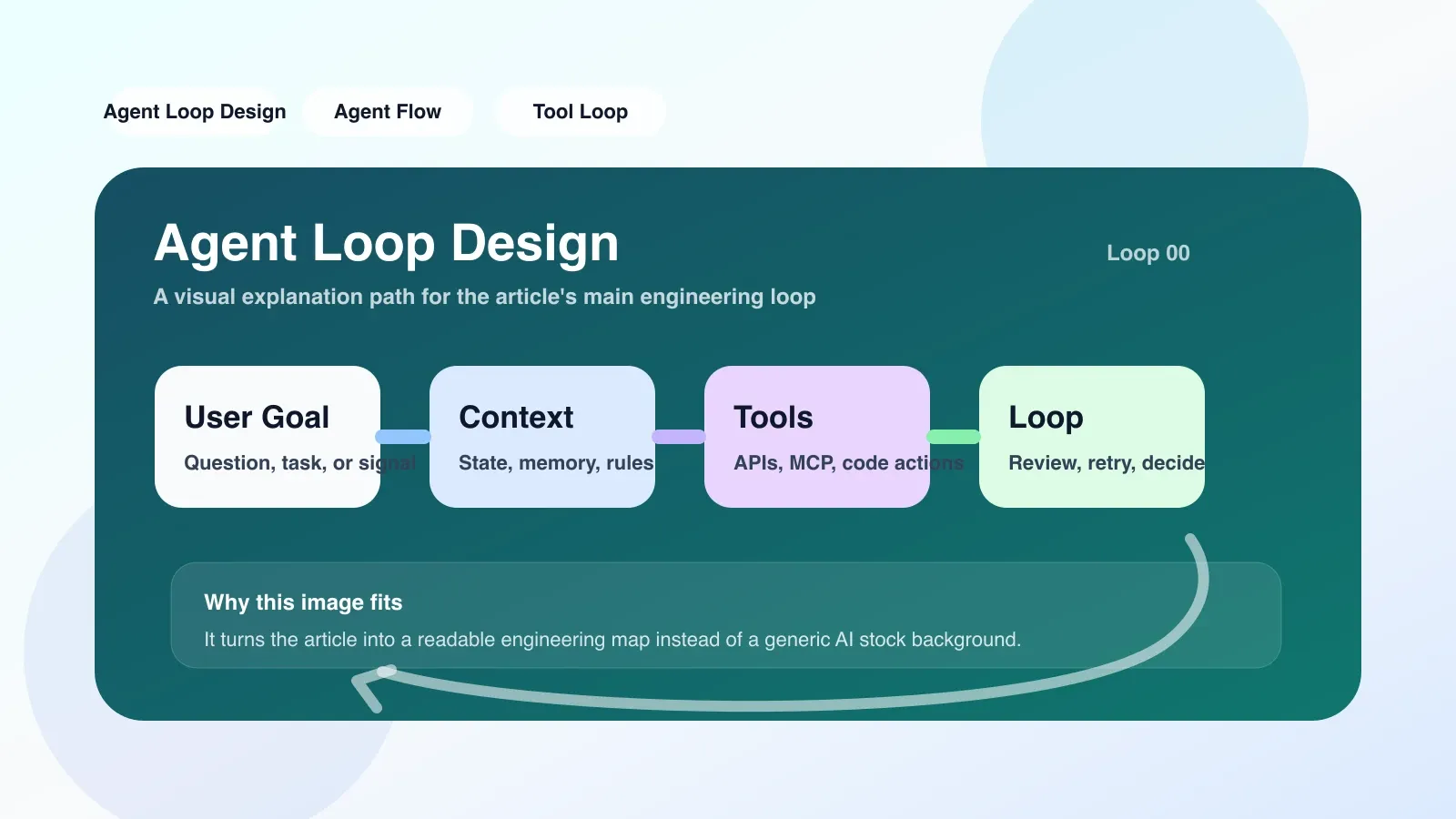
AI Agents are no longer just chatbots. When developers try to let AI autonomously complete multi-step tasks—such as automatically fixing code, continuously scraping website data, managing Kubernetes clusters—a core question arises: **How does the Agent decide what to do next, when to stop, and how to handle errors? ** This is exactly the question Agent Loop Design aims to answer.
From OpenAI's Function Calling to Anthropic's Tool Use, and then to various open-source Agent frameworks, the underlying cycle is inseparable: observing status, making decisions, executing, updating status, and observing again. The design quality of this cycle directly affects the agent's reliability, cost, and debuggability.
What engineering problems does it actually solve?
Without an Agent Loop, developers typically write hardcoded if-else or state machines to control the task flow. But once task complexity increases—such as "automatically modifying code based on user feedback and running tests"—the hard-coded path becomes unmaintainable. Agent Loop Design addresses three core issues:
- When Decision Is Triggered: Does the loop start every time a user input, or is it based on events or state changes?
- Where is the loop boundary: Under what conditions can a loop be safely exited? Timeout, goal reached, or manual interruption?
- Context Maintenance: Between each loop iteration, which states should be retained and which can be discarded?
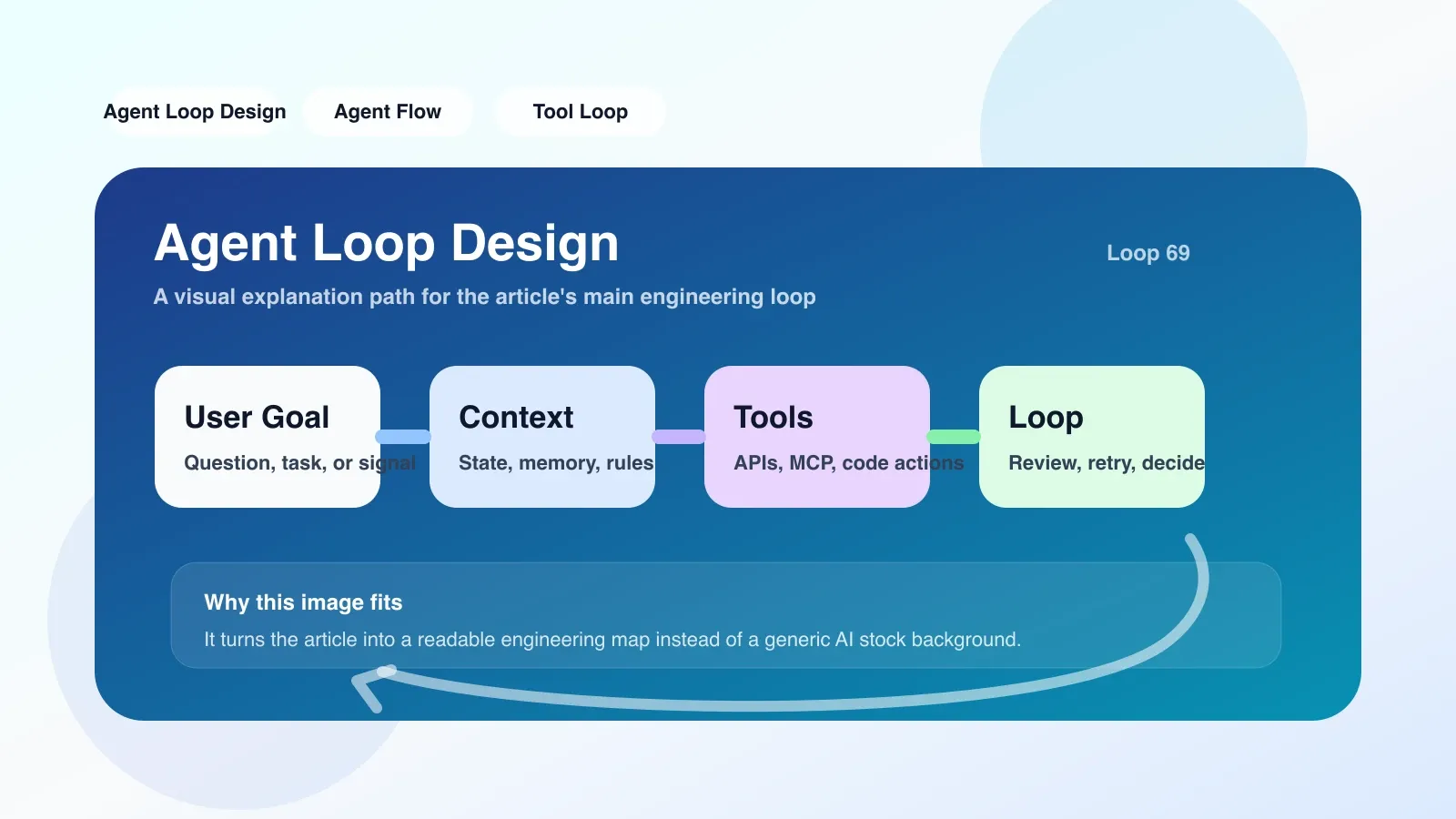
A typical design is: the Agent receives the initial target, calls tools (such as file editing, API requests) in the loop, observes the results, and then decides on the next step. If the result meets expectations, the cycle ends; Otherwise, keep going. However, if the tool calls keep returning errors, the loop may run infinitely or consume a large number of tokens.
The Most Prone Areas for Failure and Misunderstanding
1. There are no clear conditions for withdrawal
Many initial designs only set "task completed" as an exit condition, but in practice, "mission complete" is often vague. For example, an agent is asked to "optimize code performance," it may keep modifying and never feels "good enough." Solution: Introduce maximum iteration count, token budget cap, or user confirmation steps.
2. State management is chaotic
Each iteration of the Agent Loop may modify its state. If the state is irrecoverable, a single wrong call can contaminate the entire context. For example, if the agent modifies the configuration file but writes the wrong syntax, the next time it loads the file in a loop, causing all subsequent operations to fail. Correct Practice: Capture key states before each loop starts, or request transactional operations in tool calls.
3. Ignore errors and exceptions
The error itself is also an important signal. Many designs only judge successful outputs but ignore the error messages returned by the tools, causing the agent to repeatedly try the error cause. For example, the reason for file write failure might be insufficient permissions, but the agent will only retry the write without checking permissions. Improvement: Explicitly handles error types in loop logic, directly terminating and reporting non-recoverable errors.
If you want to implement now, what is the first step?
Don't start a loop from scratch. First, run a simple demo using an existing framework:
- Choose a lightweight framework: LangChain, AutoGen, or directly use the OpenAI Assistants API, which has a built-in basic loop mechanism.
- Clearly defined goals and termination conditions: For example, "Read the CSV file, check each row for compliance, correct non-compliant items, output logs. Perform up to 10 cycles."
- Record the input and output of each cycle: Print or store the decisions, tool calls, and results of each iteration in a structured log for easy debugging.
- Deliberately creating false scenarios: For example, returning fake data or delays to tools and observing the agent's behavior. If it falls into a vicious loop or consumes too many tokens, the existing design needs improvement.
After completing the first step, complex designs such as state persistence, multi-agent collaboration, and human-computer interaction nodes are considered.
Backup Plan in Case of Failure
When Agent Loops frequently fail or are too costly, the following alternatives can be considered:
- Degenerate to one-step call: Remove loops and instead use independent inference per user input or event trigger. Suitable for request-response mode, independent of historical status.
- Introducing Human Confirmation Nodes: Pause loops before critical steps (such as modifying production documents or performing sensitive operations) to wait for manual approval.
- Using workflow engines: For highly structured processes (such as CI/CD pipelines), replacing Agent Loops with DAGs or state machines is more controllable.
- Limiting toolsets: Reduce the number of tools an agent can call, lowering decision complexity, sometimes more effective than optimizing loops.
Real-life scenario: Automatically fix code submissions
Suppose you are building an agent that listens to PR comments in Git repositories, automatically fixes code based on comments, and pushes new commits. If using a loop design:
- Initial state: Code changes in the PR
- Loop 1: The Agent reads the comment "Variable naming does not comply with standards" and calls the tool to modify the code
- Second loop: The Agent reads the modified diff, but the modification introduces a syntax error
- Third loop: The Agent tries to fix a syntax error, but the fix breaks other features
- Infinite loop: An agent can never simultaneously satisfy naming conventions and functional correctness until the maximum number of iterations is reached
In this scenario, the failure is that the agent does not distinguish between the priorities of "code style" and "function correctness." Correct Design: Incorporate quality access control into the loop, first perform functional verification (test passed), then style correction to avoid repeated cross-modification.
Where to go for systematic learning next
Agent Loop Design is just one part of the Agent project. If you want to systematically master state management, tool orchestration, multi-agent collaboration, and human-computer interaction design, you can delve deeper into the following directions:
- Read the source code of mainstream Agent frameworks to understand their Loop implementations
- Learning the "environment-agent" interaction pattern (MDP) in reinforcement learning, which, although different, shares the same concept
- Pay attention to standardized interfaces like MCP (Model Context Protocol), as they affect how state is passed in Loops
No comments yet. Be the first to share your thoughts.