
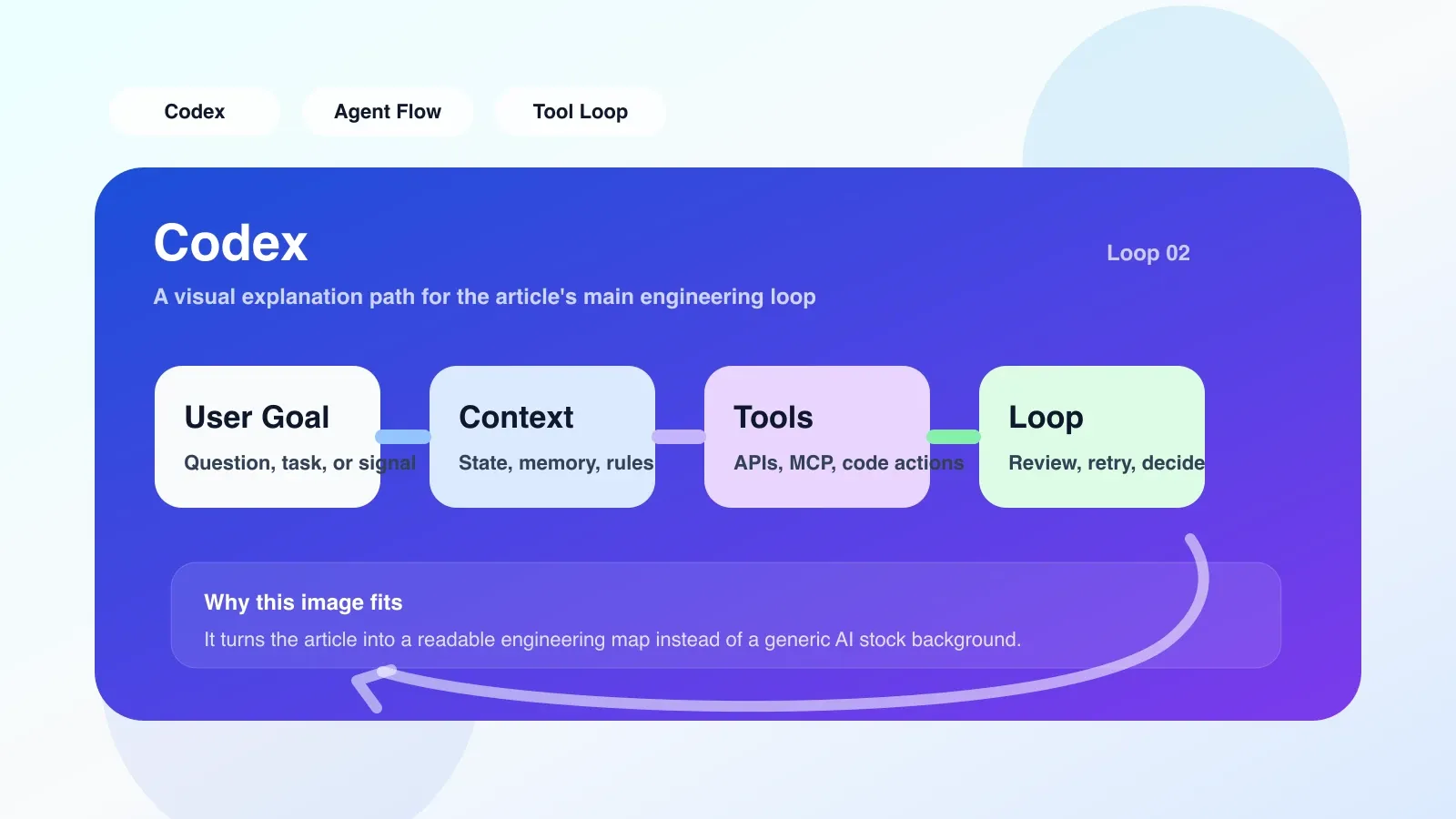
Codex vs Loop Engineering: Choose a tool that can write code first, or build an engineering closed loop that can converge first?
When many teams compare Codex vs Loop Engineering, they tend to regard them as the same level. A more practical understanding is: Codex is more focused on execution tools or agent capabilities, while Loop Engineering is more focused on workflow and iterative methods. If you now only want AI to help you read code, change code, and run tasks, give priority to Codex; if you are already using AI to write code, but the results are unstable, reworked a lot, and difficult to evaluate, then what you lack is usually not another model term, but a closed-loop engineering method such as Loop Engineering.
Let me start with the conclusion in one sentence: If you want to start faster, use Codex; if you want to scale up more stably, use Loop Engineering; what most real teams ultimately need is a combination of "execution layer like Codex + process layer like Loop Engineering". **
Concept explanation
Codex is more like what?
In this context, Codex can be understood as: Execution layer capabilities that allow AI to directly participate in code understanding, modification, command execution and task advancement. What it solves is the problem of "how does AI really enter into the development process to do things?"
You'll typically use it to:
- Read the warehouse structure and existing implementations
- Generate or modify code according to instructions
- Run tests, check output, proceed with fixes
- Continuously advance tasks in a more complete context
Therefore, the value focus of Codex is: turning natural language intentions into executable software work.
What is Loop Engineering more like?
Loop Engineering can be understood as: A method of establishing a stable closed loop around "goal definition->task dismantling->execution->feedback->evaluation->re-execution". It is not a single tool, but a way of organizing engineering.
The issues it is more concerned about are:
- Whether the task is broken down into small enough pieces for the AI to complete continuously
- How to judge whether the results are acceptable after each round of execution
- After failure, should you continue trying, roll back, or change strategies?
- How to string prompts, context, tool calls, and evaluation criteria into a stable process
Therefore, the value focus of Loop Engineering is: Making AI workflow repeatable, evaluable, and convergent.
The two are not synonyms
The most common misunderstanding is to regard both as "an AI programming product". In fact, a more accurate distinction is:
- Codex favors "who will do the work"
- Loop Engineering prefers "How can this be done right continuously?"
If you only use execution tools without closed loops, you will get a lot of results that look runnable but are difficult to reuse. On the other hand, if we only talk about loops without access to the execution layer that can actually read and write code and run commands, the process will be difficult to implement.
Implementation principle: The two solve problems at different levels.
Core mechanism of Codex
From an engineering perspective, capabilities like Codex usually rely on three things being true at the same time:
- Context input: Provide the code repository, task goals, constraints, and existing output to the model.
- Action Execution: The model not only "answers", but can also change files, read logs, run commands, and continue iteration.
- Turn Advance: Each result will affect the next action until the task is completed, fails, or is handed over to humans.
In other words, Codex's strength is not just generating code, but continuously advancing work in the context of tasks.
The core mechanism of Loop Engineering
What Loop Engineering is really trying to create is a feedback loop that can be run over and over again:
- Define goals: What needs to be changed and what is achieved to be considered successful.
- Break down tasks: Divide large goals into steps that the AI can complete independently.
- Execution round: Call models, tools, and context to produce results.
- Check results: Check whether tests, rules, manual review, and indicators pass the line.
- Decide on the next step: continue repairing, switch strategies, rollback, and terminate.
The focus of this mechanism is not "how smart a single generation is", but knowing after each round whether you should continue and why.
###Why many teams compare them
Because in real AI coding scenarios, teams usually face two problems at the same time:
Execution issue: Can AI directly participate in changing the code?Stability issue: How can things modified by AI become a controllable process?
Codex responds more directly to the first question, Loop Engineering responds more directly to the second question. Comparing them is essentially to compare whether what you currently lack most is execution entry or engineering closed loop.
How to choose?
Suitable for cases where Codex is given priority
If you meet most of the following conditions, it is more cost-effective to go to Codex first:
- The team is still in the early stages of getting AI to actually work
- The current main bottlenecks are slow code reading, slow code modification, and many repetitive tasks.
- There are not enough AI usage scenarios yet. It is more important to verify the value first than to build complex processes first.
- What you need is an execution layer that can enter the development process as quickly as possible
In this kind of scenario, the most important thing is to answer first: Can AI reliably produce usable output in your code base? ** If this problem has not been verified, talking about the complete loop first will often lead to premature design.
Suitable for situations where Loop Engineering is given priority
If you meet most of the following conditions, Loop Engineering is more worth applying for first:
- Teams are already using AI to write code, but the results are mixed
- The output of the same task fluctuates greatly each time, resulting in serious rework
- You start to care about evaluation, regression, failure retry, auditing and responsibility boundaries
- Different members write their own prompts, and the process cannot be settled.
The core of this type of scenario is not to change to a tool that is better at writing code, but to establish a closed loop where failure is visible, success is reusable, and quality can be checked.
A simple judgment method
You can ask yourself two questions directly:
- What you are missing now is "Can AI start doing things?" If so, look at the Codex first.
- What you are missing now is "Why is AI always unstable when doing things"? If so, look to Loop Engineering first.
If both problems exist, the order in reality is usually: **First use an execution layer such as Codex to run 2 to 3 real tasks, and then use Loop Engineering to fix the path to success. **
Applicable boundaries: None of them are universal solutions
Codex boundaries
Execution tools like Codex are not suitable for deification. In the following scenarios, it is often not enough when used alone:
- The requirements themselves are unclear, and no one can even explain what needs to be changed.
- The warehouse lacks testing, specifications and verifiable standards
- The task involves strong business judgment and cannot be completed just by "reforming it and running"
- The team needs strict auditing, approval chain and division of online responsibilities
The problem at this time is not whether AI can write code, but that the input and acceptance mechanism itself is incomplete.
Boundaries of Loop Engineering
Loop Engineering also has clear boundaries:
- If the team does not have real use cases yet, building a closed loop first will become idle.
- If there is not enough execution layer capability, the loop will only stay in the flow chart
- Small teams, short tasks, and one-time needs may not be worth the complexity of the closed loop.
- Without evaluation data or acceptance criteria, more loops are just repeated guesses.
In other words, Loop Engineering is not a substitute for concrete model capabilities, tool access, and contextual quality.
Where both will fail together
No matter which side you choose, as long as the following situations occur, the results will be poor:
- The context is too large but unfocused, and the AI cannot find key constraints.
- The tasks are split too roughly, too many goals are crammed into one round
- There is no clear "definition of completion", you can only judge by feeling
- No rollback or alternate paths after failure, resulting in repeated code pollution
- The team mistook demo-level success for production-level availability
These are not terminological issues, but engineering discipline issues.
Cases and practical points
Practice 1: Individual developers want to improve delivery speed
If you are an individual developer, independent developer, or the main engineer in a small team, Codex is usually the first to benefit.
A more pragmatic approach would be:
- First choose a small task with clear boundaries, such as supplementary testing, fixing a clear bug, and implementing a single interface
- Provide clear input: target files, constraints, acceptance methods
- Use test or output results in each round to determine whether to continue
- Record success prompts, common constraints and failure modes
There is no need to build a large system here. The point is to quickly identify: **Which tasks are suitable to be handed over to AI and which are not. **
Practice 2: The team begins to use AI programming on a large scale
If you are no longer "trying it out", but are ready to let multiple people use AI continuously, then the value of Loop Engineering will obviously increase.
More effective landing spots often include:
- Define fixed input templates for common tasks
- Split tasks into shorter rounds to avoid single-round overload
- Forced insertion of checkpoints after each round, such as testing, lint, manual confirmation
- Default branches for failure situations: retry, downgrade, manual takeover
- Accumulate success examples and failure examples instead of just accumulating prompts
The result of this is that AI is no longer just "occasionally amazing" but closer to a manageable productivity component.
Practice 3: Combine first, then optimize
In most cases, it is not a matter of choosing one of the two, but a layered combination:
- Use Codex to understand, edit, and execute code
- Use Loop Engineering to specify how to enter, check, and exit tasks
This combination is particularly suitable for the following goals:
- Reduce AI programming rework rate
- Improve reusability among team members
- Consolidate "personal skills" into "team processes"
The easiest trap to step into
Pitfall 1: Treat Codex as a complete methodology
If you only see "it can change the code" but there is no closed loop of acceptance and feedback, the result is usually an increase in short-term efficiency and an increase in long-term maintenance costs. Because what you get is more changes, not necessarily more deliverables.
Pitfall 2: Treat Loop Engineering as a ready-to-use product
Loop Engineering is essentially more of an engineering organization. It cannot automatically solve basic issues such as context, model, tool, and warehouse quality for you. Without the cooperation of the execution layer and the verification layer, the loop can easily stop at the conceptual layer.
Pitfall 3: Premature complication
Before the team can find 1 or 2 stable and high-value scenarios, they start to build multiple layers of processes, templates, and indicators, which will only increase the burden in the end. It is a more stable order to verify the task type first and then talk about scale.
Fallback plan in case of failure
If neither Codex vs Loop Engineering gives you the desired results, you can downgrade in this order:
- Reduce task granularity: Return from "large function development" to "make up for testing, fix bugs, and change single file logic".
- Reduce contextual noise: Provide only the code, rules, and acceptance criteria needed to complete the task.
- Introduce manual checkpoints: Do not require AI to go through the entire process at once and return key nodes to human judgment.
- First solidify a single workflow: For example, only PR review assistance, test completion, or document synchronization are run through.
- Temporarily abandon full automation: Change to semi-automatic mode of "AI makes suggestions, humans decide and submit".
The purpose of this type of backup plan is not to retreat, but to bring the problem back under control.
Where to go next
If you have read this far, you should have been able to answer five core questions: what are they, why are they important, how to choose, where will failure, and what to do after failure. The next step should not stop at terminology comparison, but should enter agent engineering practice for real development tasks.
If your goal is to shift from ordinary developers to more systematic Agent engineering capabilities, the point is not just to look at a few more hot words, but to complete these pieces:
- Contextual organization skills
- Tool calling and workflow design
- Failure loop and evaluation mechanism
- From a single prompt to a method of depositing reusable engineering assets
This is also the watershed from "being able to use AI" to "being able to do AI engineering".
No comments yet. Be the first to share your thoughts.