
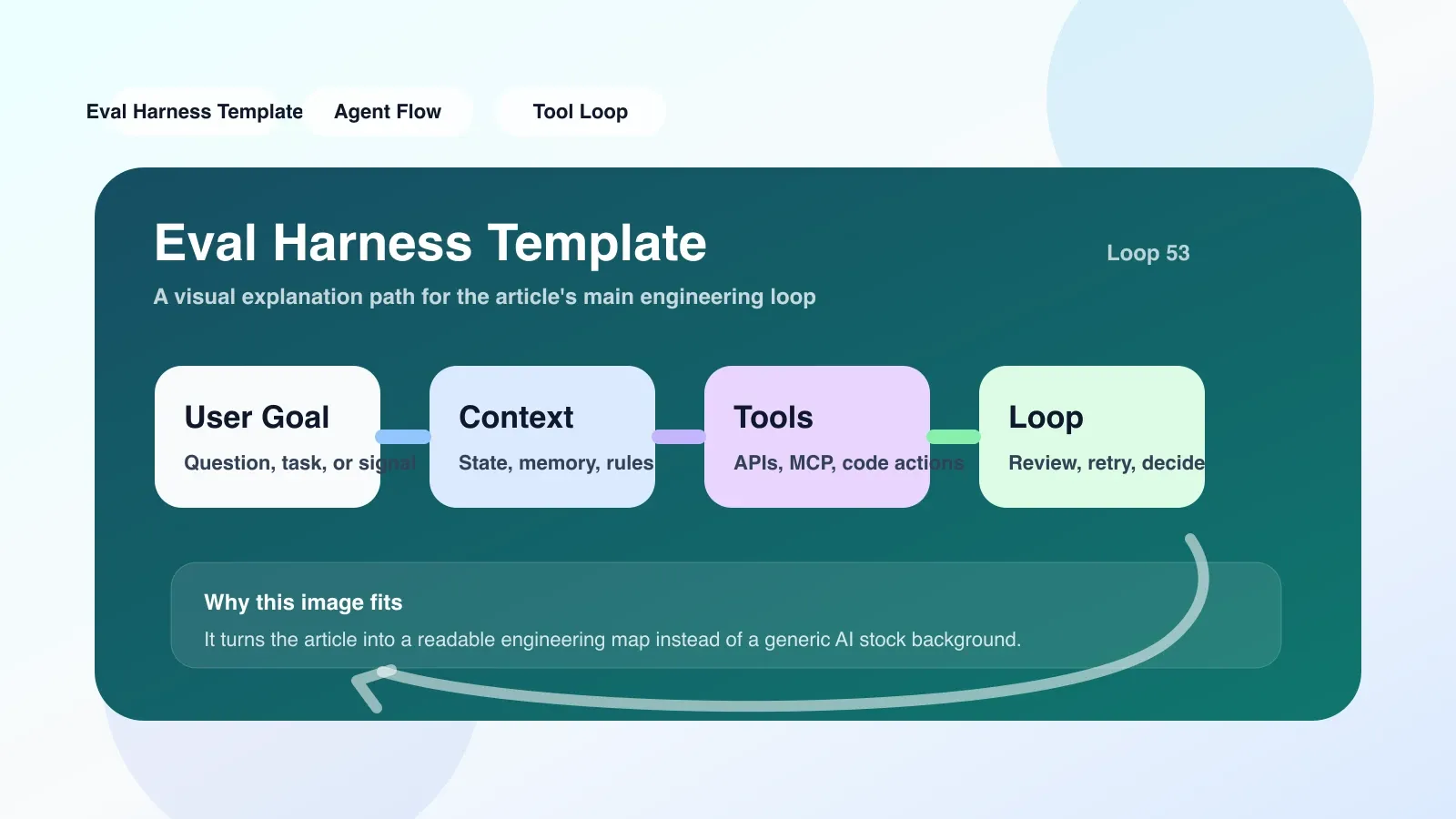
Why do you need eval harness template?
To evaluate whether a AI agent is "easy to use", it is far from enough to manually look at a few cases. You need a repeatable, quantifiable testing process, and that's where the eval harness template comes in. It is essentially a standardized evaluation framework: you define test cases, scoring rules and running environments, and harness automatically executes and reports the results.
But there are many pitfalls in actual implementation. I recently built an evaluation pipeline for the company's customer service agent, and encountered three of the most typical pitfalls: The template itself does not maintain dependent versions, The metric configuration is misaligned with the business goals, and The evaluation design for multiple rounds of interactions is missing. Below I use my project link to explain clearly how to do each step.
A real link: building an eval harness from scratch
1. Select template and initialization environment
The mainstream choices are lm-evaluation-harness (maintained by EleutherAI) or custom lightweight templates. I chose the former because it supports huggingface model and custom tasks.
# 克隆并安装(务必用 Python 3.10+)
git clone https://github.com/EleutherAI/lm-evaluation-harness.git
cd lm-evaluation-harness
pip install -e .
最容易失败的地方:依赖冲突。如果你的项目同时使用 transformers 4.30 以上版本,eval 库可能不兼容。建议新起一个虚拟环境,且固定 torch 版本为与你本地一致的镜像。否则可能花半天排查 CUDA error: device-side assert triggered。
2. 定义 task:用 YAML 描述评测内容
核心是写一个 YAML 文件,告诉 harness:任务名称、数据集、prompt 模板、输出解析方式和 metric。我的客服 agent 需要评估“能否正确引用知识库回答客户问题”,于是定义了如下 task:
# tasks/my_kb_qa.yaml
task: my_kb_qa
dataset_path: json
dataset_kwargs:
  data_files: eval_samples.jsonl  # 包含输入 query、上下文、预期答案
doc_to_text: "问题:{{query}}\n上下文:{{context}}\n请根据上下文回答问题:"
doc_to_target: "{{expected_answer}}"
training_split: null
output_type: generate_until
target_delimiter: ""
metric_list:
  - metric: exact_match
  - metric: f1
  - metric: "rouge"
    aggregation: mean
    higher_is_better: true
误区:很多人直接把评测集与训练集混用。eval 数据必须完全独立,且 domain 分布要覆盖目标场景的典型查询。我第一版拿客服 chat log 里的简单问题跑,得分 0.95,上线后发现真实用户问长尾问题几乎全挂。原因是评测集缺乏边缘 case。
3. 运行 eval 并解读结果
python main.py --model hf --model_args pretrained=my-agent-v1 --tasks my_kb_qa --batch_size 4 --device cuda:0
The output will give you the score and summary for each sample. But looking only at averages is dangerous. You should pay attention to:
- Quantile distribution: Median and p10 are more reflective of tail performance.
- Split by query type: If the data has a type field, group statistics are recommended.
One of my experiments averaged an exact_match of 0.78, but found that the "multi-step instruction" class query scored only 0.12. This shows that the main flow is passed but complex scenes are not covered.
4. Iteration: Inject the failure case into the evaluation set
After discovering the vulnerability, you should desensitize the real online failed query and add it to the eval set, and update the data set in YAML synchronously. This process is to continuously maintain the eval harness template, rather than writing it once and using it forever.
Applicable boundaries and alternatives
**Who is the eval harness template checklist suitable for? **
- You are developing or fine-tuning the AI model/agent and need to quantify changes in capabilities.
- If the team has more than 2 people, the evaluation standards need to be unified.
- The project has clear business indicators (such as accuracy, recall).
**What is the easiest pitfall to step into? **
- Task definition is divorced from real use cases: YAML is written perfectly, but the evaluation data is toy level.
- Ignore multi-round interaction: Many harnesses default to single-round QA, and agent evaluation needs to expand multi-round logic by itself.
- Improper metric selection: exact_match is too strict for the generation task. It is recommended to use ROUGE/BLEURT or LLM-as-judge first.
**What is the backup plan in case of failure? ** If the template compatibility issue cannot be solved in a short time, fall back to script-level custom evaluation: use pytest + your business logic to directly verify the agent output. Although it is not standardized, it can be run through quickly. Migrate back to harness later.
What’s next?
Running eval through is only the first step. More importantly, the evaluation results are used to guide agent design (coordination of context, memory, and workflow). If my customer service agent continues to perform poorly on multi-turn and complex commands, then what needs to be adjusted is not the prompt, but the permission structure and tool call scheme.
If you want to transform from an ordinary developer to an Agent engineer, the next step in this article should be a more systematic original paid article or course. High-quality original paid articles and AI advanced programming courses will help you more completely master eval design, agent architecture and production-level optimization.
Summary
- Choose a template and isolate the environment: Use lm-evaluation-harness or a custom template, and be sure to create a new virtual environment to avoid dependency conflicts.
- Data quality must be strictly controlled when defining tasks: The evaluation set must cover the real distribution, including edge cases.
- Run and dig into anomalies: Don’t just look at the average score, analyze quantile and category performance.
- Continuous iteration of the evaluation set: Continuously inject online failure cases to keep the corpus fresh.
- Know when to abandon the template: When it gets stuck quickly, use the pytest script to put out the fire first, and then return to the harness.
No comments yet. Be the first to share your thoughts.