
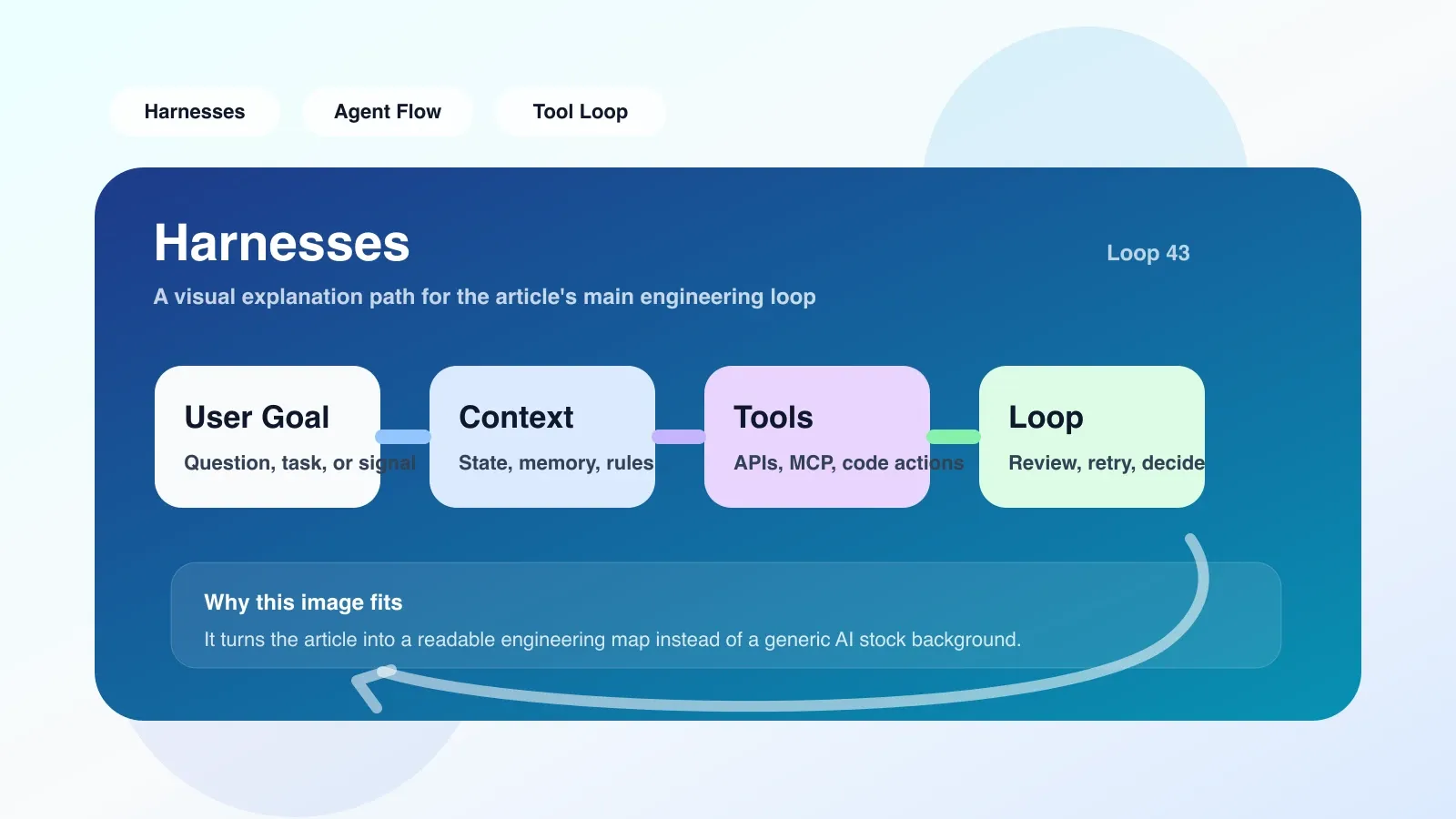
Harnesses vs Loop Engineering: Build guardrails first, or write loops first?
If you are doing AI coding, Agent workflow or evaluation-driven automated development, these two words point to two different engineering focuses: Harnesses is more like "repeatable, verifiable, observable testing and running shells", Loop Engineering is more like "designing states, steps, feedback and exit conditions around the agent loop itself".
For most people who have just entered Agent engineering, the real question is not to choose one of the two, but: Is your current main risk "the results are unstable and cannot be reproduced" or "the process will not advance itself and will not be corrected in feedback". The former gives priority to Harnesses, the latter to Loop Engineering.
Concept explanation
What are Harnesses?
In this context, Harnesses can be understood as a layer of engineering guardrails: it is responsible for organizing models, tools, inputs, outputs, logs, evaluations, regression checks, and failure reproduction into a repeatable framework.
It usually answers these questions:
- How different is the result of the same task between today and tomorrow?
- Which step failed, a prompt word, a tool call, or context contamination?
- After changing the model, parameters or tools, is the effect improved or degraded?
- After a new person takes over, can the experiment be repeated under the same conditions?
Therefore, the core value of Harnesses is not to "make the Agent smarter", but to make the system more controllable.
What is Loop Engineering?
Loop Engineering focuses more on how the agent loop itself works:
- In a cycle, what should be observed first, then what should be decided, and then what should be executed?
- When to continue and when to stop -Whether to retry, downgrade, rewrite the task or handle it after failure
- How multi-round context is compressed, retained or discarded
Its core question is not "whether it can be tested", but whether the process can continue to advance to acceptable results.
The relationship between the two
The two are not mutually exclusive. More precisely:
- The Harnesses are responsible for outfitting the system with "tracks, guardrails and scoreboards"
- Loop Engineering is responsible for designing "how players run, how many laps they run, and when to stop"
If you only do Loop and not Harness, the system may seem to run, but it will be difficult to review, optimize and deliver stably.
If you only do Harness and not Loop, the system may have a complete evaluation, but the agent itself will not handle complex multi-step tasks.
Implementation principle
Implementation Focus of Harnesses
A practical Harness often consists of the following parts:
- Standardized Input: Fixed task samples, context templates, tool configurations, and success criteria.
- Execution encapsulation: Package model calls, tool calls, retry strategies and log output into a unified execution entry.
- Result Record: Save intermediate steps, final output, time consumption, error type, and token consumption.
- Measurement Mechanism: Compare expected results, manual rubrics or key behavioral indicators.
- Regression comparison: When you change the prompt, model or tool, you can quickly see which tasks have become better and which have become worse.
In essence, Harnesses turn “try it” into a “repeatable experiment.”
Implementation Focus of Loop Engineering
Loop Engineering is more like a state machine or task controller. Typical structures include:
- Goal Breakdown: Break down user goals into executable next steps.
- Observation-Decision-Execution Loop: Read the environment status, generate actions, and then see the feedback after execution.
- Memory and context management: retain necessary history, compress irrelevant information, and prevent the context from getting dirty.
- Exit conditions: task completion, threshold reached, continuous failure, manual takeover, etc.
- Abnormal Branch: A cover-up strategy when the tool is unavailable, the result is empty, the response is off-topic, or the loop is stuck.
Its essence is to upgrade "single call" to "multi-step closed loop".
Why engineering teams tend to confuse the two
Because when many teams first build Agent, they will stuff all the following things into one script:
- while loop
- prompt splicing
- Tool call
- Log printing
- Judgment of results
- Manual acceptance
This can lead to confusion of responsibilities. A clearer layering is:
- Loop is responsible for decision-making flow
- Harness is responsible for observation, evaluation, regression and reproduction
In this way, you can distinguish whether the problem lies in "the agent can't do it" or "you can't stably judge how well it does it."
How to choose?
Prefer Harnesses
You are more suitable to do Harnesses first, if what you mainly encounter now is:
- The same task is run several times, and the results fluctuate greatly.
- There is no unified acceptance method for "good or bad" in the team
- Every time I change the prompt or change the model, I don’t know if there is any real improvement.
- Unable to reproduce the problem path after online failure
- Are you ready to hand over the AI coding process to multi-person collaboration?
In this case, by adding Harness first, the profit is usually higher than by continuing to add circular logic. Because there is no verifiable base, subsequent optimizations can easily become sensory-driven.
Prioritize Loop Engineering
You are more suitable to do Loop Engineering first, if your current bottleneck is:
- A single round of model calling cannot complete the task and requires multi-step planning and execution.
- Tasks rely on external tools, file systems, code modifications, or environmental feedback
- Models often get stuck in intermediate steps and don’t know what to do next
- You need failure retry, task splitting, state recovery or manual takeover
In this case, designing the loop first is more critical than simply adding evaluation. Because the system does not even have a complete action chain, no matter how detailed the measurement is, it will only measure an incomplete process.
A simplified judgment method
It can be judged in one sentence:
- If you are most afraid of "uncertainty", do Harnesses first
- If you are most afraid of "not being able to run", do Loop Engineering first
Applicable boundaries
What Harnesses are not suitable for solving
Harnesses are not a panacea. It does not directly address these issues:
- The agent has no ability to decompose tasks at all
- The tool interface design is confusing, and the model cannot use the tool even after receiving it.
- The context window is polluted and core information is constantly lost
- Your success criteria themselves are poorly defined
If the process logic is weak, Harness can only prove more clearly that "it really doesn't work," but it can't fill in the intelligent decision-making for you.
What Loop Engineering is not suitable to solve
Loop Engineering also has clear boundaries. It's not good at solving alone:
- Optimization distortion caused by lack of repeatable evaluation
- After making one change, I don’t know if the overall regression has gotten worse.
- Experiments during multi-person collaboration cannot be reproduced
- Difficulty locating online issues
Without Harness support, the more complex loops there are, the higher the troubleshooting costs are usually.
Failure scenario
The most common failure is not the wrong choice of technical terms, but the wrong order:
- First pile up complex loops, but there is no evaluation baseline. In the end, it is impossible to judge whether there is real progress.
- Do a lot of testing infrastructure first, but the agent capability is too weak and all tests fail steadily.
- I wanted to complete two systems at once, but the development cycle was lengthened and the core problem was not solved.
Cases and practical points
Scenario 1: AI encoding agent makes multiple file modifications
If your agent needs to read code, modify multiple files, run tests, and then continue to make corrections based on error reports, this is obviously beyond the capabilities of a single round of calls. Here Loop Engineering is just needed because you need:
- Read current status
- Decide which file to change next
- Perform modifications
- run tests
- Continue looping or stop based on failure result
But once it becomes available, the next phase immediately exposes Harness requirements:
-Which type of tasks has a higher passing rate?
- Which model upgrade caused the regression?
- Which tool step is most likely to fail?
The practical sequence for this type of scenario is usually: **Let the loop run through first, and then add the harness for stabilization. **
Scenario 2: Comparison of Prompt, model and tool solutions
If you already have a set of clear tasks on hand, such as "generating scripts", "fixing simple bugs", and "explaining error reports", and you mainly want to compare the effects of different models or different prompt word strategies, Harnesses should be used first.
Because the core at this time is not to make the process longer, but to make the experiment more credible.
Scenario 3: The team moves from prototype to deliverable
In the personal prototype stage, many people can accept "run first and then talk". But once you enter the team collaboration, customer delivery or paid product stage, you will often encounter several problems without Harness:
- Unable to define stable SLA
- Unable to track version regressions
- Unable to precipitate high-value failed samples
- New members cannot take over quickly
So the Loop is more like a prototype amp and the Harness is more like a delivery amp. If you want to move from demo to engineering, you usually need both in the end.
The easiest trap to step into
Think of Harnesses as "More Logs"
Logs are just records, not Harness. A true Harness allows you to reproduce, compare, review, and return, rather than just turning over the console after failure.
Write Loop Engineering as an infinite loop
Many agents fail not because the model is not strong enough, but because the loop does not have clear exit conditions, resulting in:
- Call the same step repeatedly
- Make more bugs to fix bugs
- Token costs are out of control -Contextual noise continues to accumulate
Loops must have stopping mechanisms, failure thresholds, and manual takeover points.
Premature abstraction
Some teams want to build a “universal Agent platform” from the very beginning. As a result, Harness didn't play well and Loop didn't play well. A more pragmatic approach is to first close the loop around a specific workflow, such as a code modification loop, a document generation loop, or a work order processing loop.
Fallback plan in case of failure
If you find it difficult to advance both ways, you can use a more conservative transition plan:
- First reduce the task into a single-step or two-step process to avoid entering complex loops prematurely.
- Record input, output, errors, and manual scoring with minimal Harness.
- Reserve manual confirmation for high-risk steps and do not insist on full automation.
- After you get stable failure samples, you can decide whether to fix the loop or the harness first.
The value of this solution is that even if the automation capability is still weak, you can first accumulate real task data instead of staying in conceptual discussions.
Actual selection suggestions
If you are an individual developer or a small team, you can do it directly in the following order:
- The task is a multi-step execution type: first do the minimum loop, and then add the minimum harness.
- The task is a comparison and evaluation type: first make the minimum harness, and then decide whether loop is needed.
- The task is already delivery-oriented: Don’t choose one or the other, at least make the minimum available version.
Really mature Agent Engineering is usually not Harnesses vs Loop Engineering, but Harnesses + Loop Engineering, but with different priorities.
Next step
If you can already distinguish the responsibilities of "guardrail system" and "agent loop", the next step should not stop at understanding terminology, but should enter more systematic Agent engineering training: how to design context, how to connect MCP, how to do loop control, and how to turn experimental processes into deliverable capabilities.
If you want to switch from an ordinary developer to the Agent engineering direction, the point is not to memorize a few hot words, but to put these concepts into an executable workflow.
No comments yet. Be the first to share your thoughts.