
Why the transition to Agent Engineer leaves many developers stuck
You may have seen many Agent demos: AI automatically writes code, adjusts APIs, and handles multi-step tasks. But when you do it yourself, you find that the difference between "writing a script" and "arranging an Agent workflow" is not just API calling experience, but a whole set of engineering thinking about context management, tool calling, fault tolerance, and state recovery.
The value of Codex fills this gap. It's no ordinary AI code completion tool—it converts natural language instructions directly into executable code, and it understands the context of your codebase. However, many developers overestimate its autonomy and underestimate its requirements for engineering thinking.
Codex What kind of Agent engineering capability shortcomings are we trying to make up for?
Traditional developers are good at writing functions, modules and services, but the core of Agent engineering is to "let the AI model make decisions and execute autonomously in the loop." Codex The three key shortcomings to be addressed are:
- Fast cashing out from context to code: You describe an intention, and Codex can generate the corresponding call chain. For example, if you say "Write a function, first check user permissions, then call the API to pull data, and finally format the output," it can directly provide a three-part code. This is much faster than manual assembly.
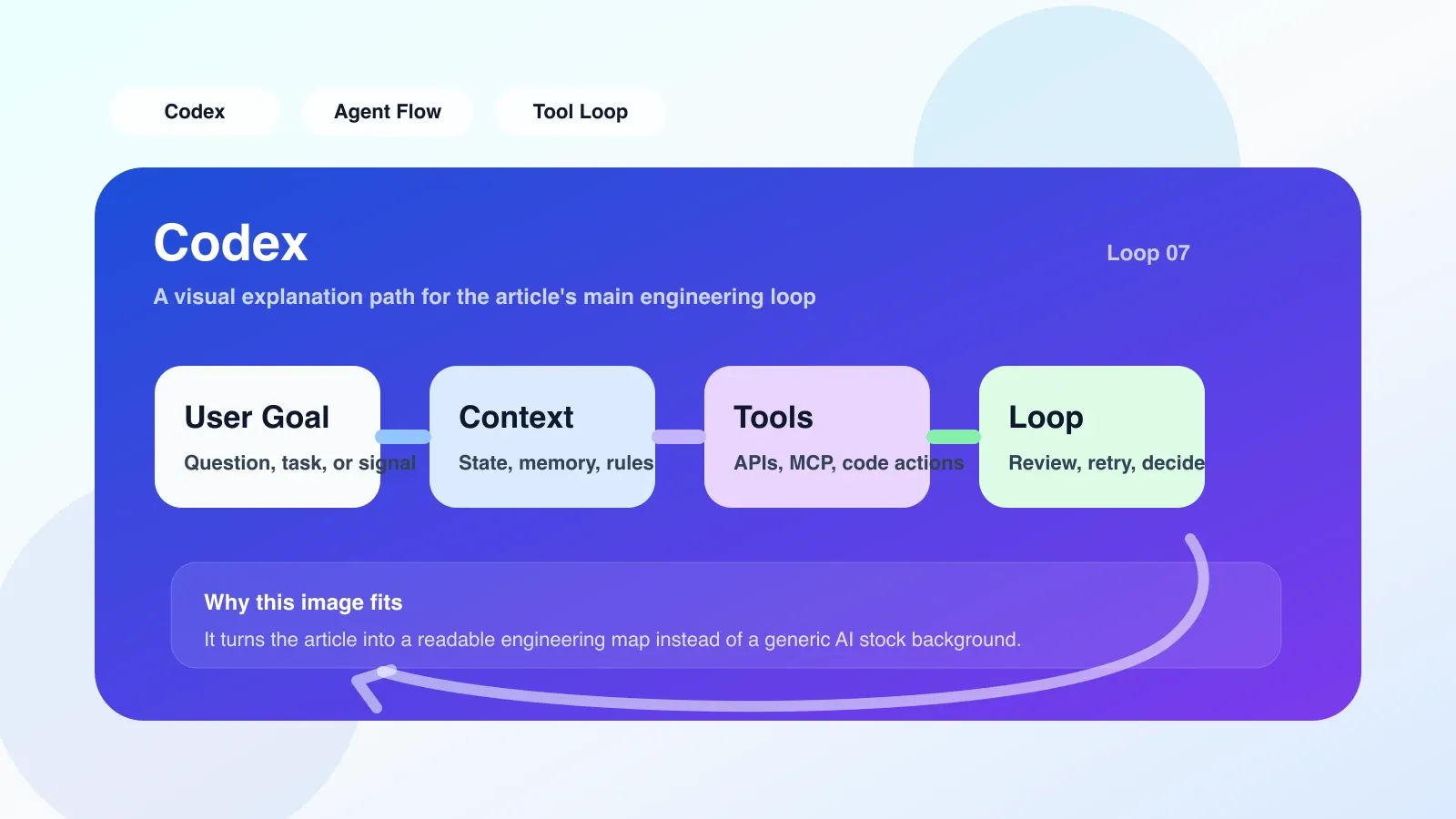
- Draft generation of multi-step action choreography: Agent often needs to execute a sequence: sensing environment → decision → execution → feedback. Codex can use natural language description to quickly build the code skeleton of this loop. You only need to adjust the fault tolerance and boundaries.
- Intent understanding of existing code bases: Codex can read the naming, patterns, and styles you already have in the project, allowing you to quickly expand Agent behavior on the existing basis. This is especially important when migrating legacy systems.
But note that Codex does not automatically do error handling, idempotent design or state recovery. The code it generates is often too optimistic - assuming that the API is always up, the data is always complete, and the environment is always consistent. This is where it's most likely to fail.
A real scenario: Use Codex to build a simple code review Agent
Let’s say you process dozens of PRs every day and want to automate the first round of checks. You can let Codex act as a censorship agent:
- Give it an instruction: "Read the diff of this PR and check for hardcoded keys, unhandled exceptions, and functions longer than 50 lines."
- Codex will generate a script, parse the diff content, and then use regular or AST analysis to find the problem.
- When actually running, you find that the script generated for the first time always misses some annotation exceptions - because the rules of Codex are too rigidly written.
This is when you really start the "Agent project": you need to optimize a single generation into a cyclic improvement - let the Agent execute first, feed back the results, and then adjust the rules and run again. Codex provides a starting point, but the iteration logic must be designed by you.
The easiest part to overestimate and underestimate during transformation
Overestimation: Codex's autonomous reasoning abilities. Many developers think that by giving Codex a complex requirement, it can generate a complete Agent end-to-end. In fact, Codex often "hallucinates" its core logic - generating code that looks reasonable but is actually buggy. You have to read every line it generates.
Underestimation: The requirement for engineering thinking. Agent is not a one-time generated script, it needs to run stably in the production environment. You need to consider:
- What should I do if the tool call times out?
- How to truncate the context window when it is full?
- How to downgrade after continuous failures? Codex won't handle this for you. Many people get stuck on "the generated code doesn't work" during the practice phase. In fact, the problem is not that Codex is bad, but that there is no failure path designed for the Agent.
I suggest you start with this real exercise
Open a technology stack project you are familiar with and write the simplest "reflection agent":
- Use Codex to generate a function that receives user questions and calls an external API to get answers.
- Then use Codex to generate a second function and check whether the result of the first function is credible (for example, whether it contains a clear error message).
- Finally, use Codex to generate a loop: if the result is not credible, modify the problem parameters and call again, and try again up to 3 times.
This exercise forces you to understand the core loop of Agent (perception → judgment → action), and at the same time exposes the boundaries of Codex: it has no problem generating call logic, but the iteration and fault-tolerance strategies are completely up to you.
The most common way to fail during practice
You are likely to encounter three types of failures:
- Codex generates an infinite loop: The retry logic is written as an infinite loop because Codex does not consider the final exit condition.
- Resource Leak: Codex The generated code opened a file or network connection but forgot to close it.
- Context Obfuscation: You let Codex modify the same function repeatedly in a session, and it starts to overwrite or lose previous modifications.
These failures are not Codex bugs, but rather that you have not established Agent engineering thinking. Every time you fail, you have to ask: If I were the one who designed this Agent, at which decision point should I add checks, timeouts, exponentiation, etc.?
When should you upgrade to systematic learning or courses?
When you find yourself repeatedly wasting time on three things, it’s time to systemize:
- Common traps generated by Codex must be processed repeatedly every time (such as infinite loops, resource leaks);
- When you need to design complex multi-Agent collaboration, you don’t know what mode to use;
- I want to deploy Agent in the production environment, but I don’t know how to monitor and rollback it.
At this point, just trying out Codex is no longer enough. You need to understand the basic framework of Agent engineering - such as ReAct mode, best practices for tool invocation, and context window management - which will be fully covered in a systematic set of original paid articles and courses.
No comments yet. Be the first to share your thoughts.