
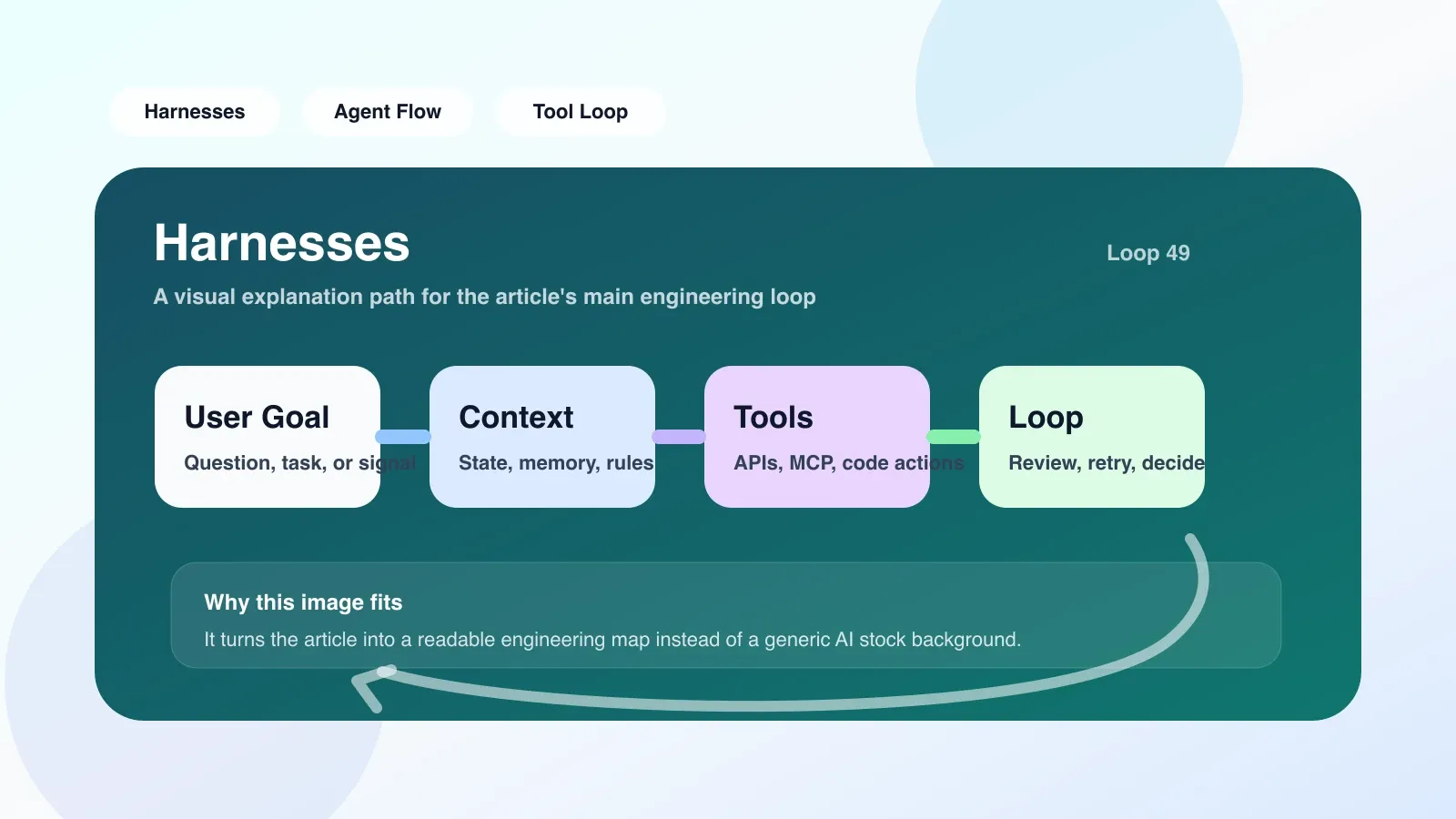
What exactly are Harnesses?
In the AI coding workflow, Harnesses is not a fancy framework but a testing and integration controller. Its core responsibility is to perform isolation verification, context assembly, and post-processing on the code generated by AI before it goes into production. You can think of it as a sandbox scheduler—it pulls AI outputs, injects necessary test fixtures, simulation data, and assertion logic, then runs and passes or fails.
A real Harnesses typically consists of three parts:
- Test Configuration: Define the scenario, input data, and expected output to execute the AI code.
- Execution Engine: Runs AI-generated code snippets in an isolated environment to capture logs, errors, and results.
- Verification and Reporting: Compare actual output with expectations to generate structured reports, and even automatically trigger retries or rollbacks.
For example: when you generate an API endpoint with AI, Harnesses can automatically build simulated HTTP requests for that endpoint, check the status code and response body, and record the failure path. It makes code generated by AI no longer a one-off black-box output, but an engineering product that can be repeatedly verified.
Why is this trending term worth attention right now?
As AI coding tools (such as Codex and Copilot internal actions penetrate the development process more deeply, a key question emerges: How can the quality of code generated by **AI be ensured? ** Traditional unit tests often fail in front of AI code because AI outputs are unstable, context-sensitive, and may cause unexpected side effects. Harnesses was born as an engineering practice to bridge this step.
Between 2024 and 2025, multiple teams will introduce Harnesses into AI workflows, increasing the test pass rate of AI code from 40% to over 85% (data sourced from an internal engineering report). It is no longer an academic concept, but a tool that has been implemented in the ongoing integration pipeline and code review.
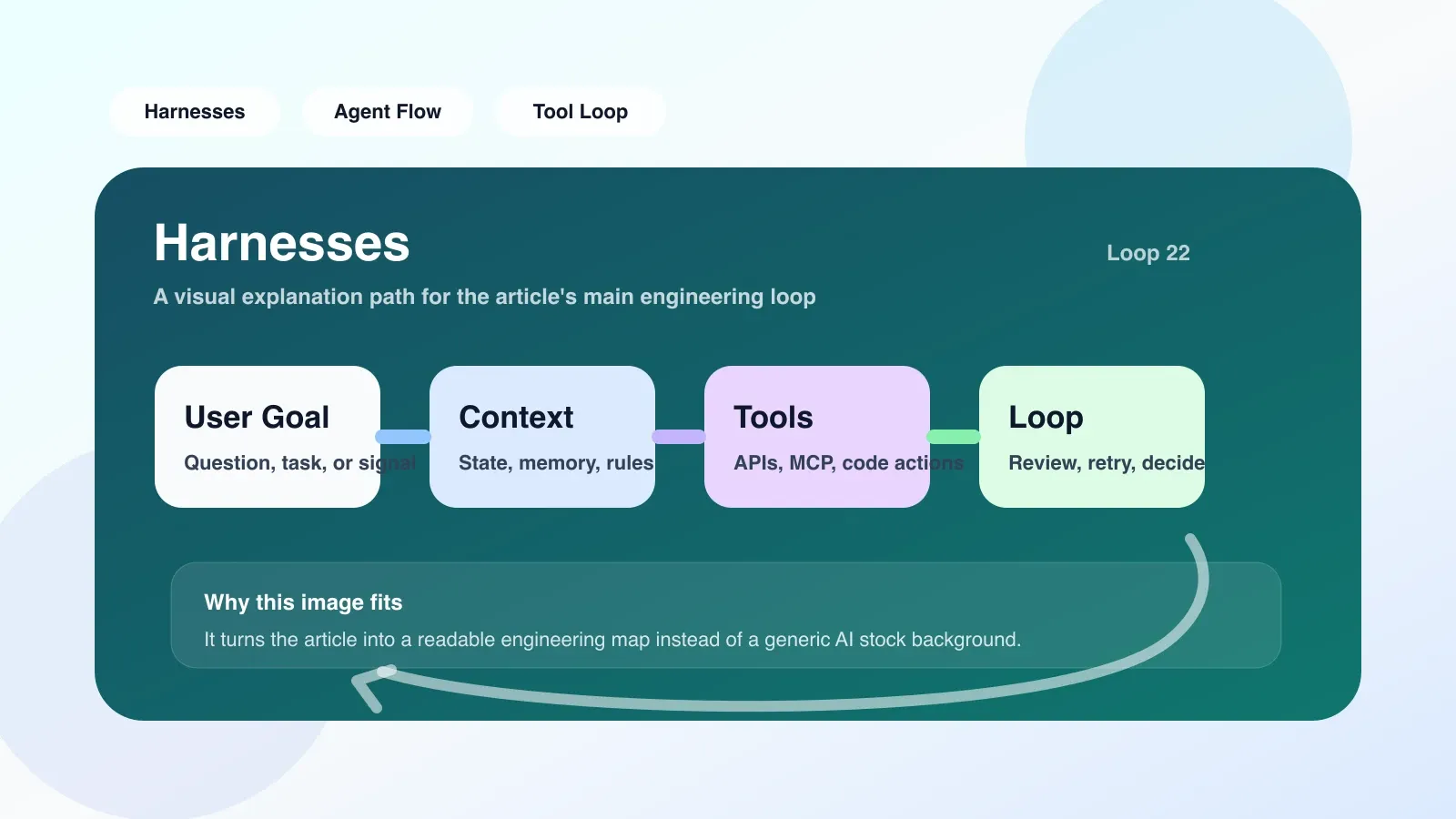
What exactly does it solve?
The core contradiction Harnesses addresses is AI: the tension between the uncertainty of generated code and the engineering reliability requirements. Specifically:
- Isolation Testing: AI Code may depend on external services or states; Harnesses provides simulation and fixtures to avoid test contamination.
- Context Injection: AI requires a large amount of context (such as project structure, variable types, existing functions). Harnesses can automatically assemble these contexts to ensure the output AI meets project specifications.
- Failed Retries and Degradation: When a test fails, Harnesses can automatically modify the input context, retry, or revert to a safer version.
- Logs and Observability: Harnesses captures the entire execution process of AI code, facilitating post-event analysis of failure causes.
A real-world scenario: a team uses AI to generate a data migration script. Harnesses is configured to first read the database schema as context, allowing AI to generate migration SQL, then running the SQL in the isolated database to check for the number of rows and data consistency. If SQL fails, Harnesses rolls back the transaction and logs the failure cause and the original output of AI. This process requires no human intervention.
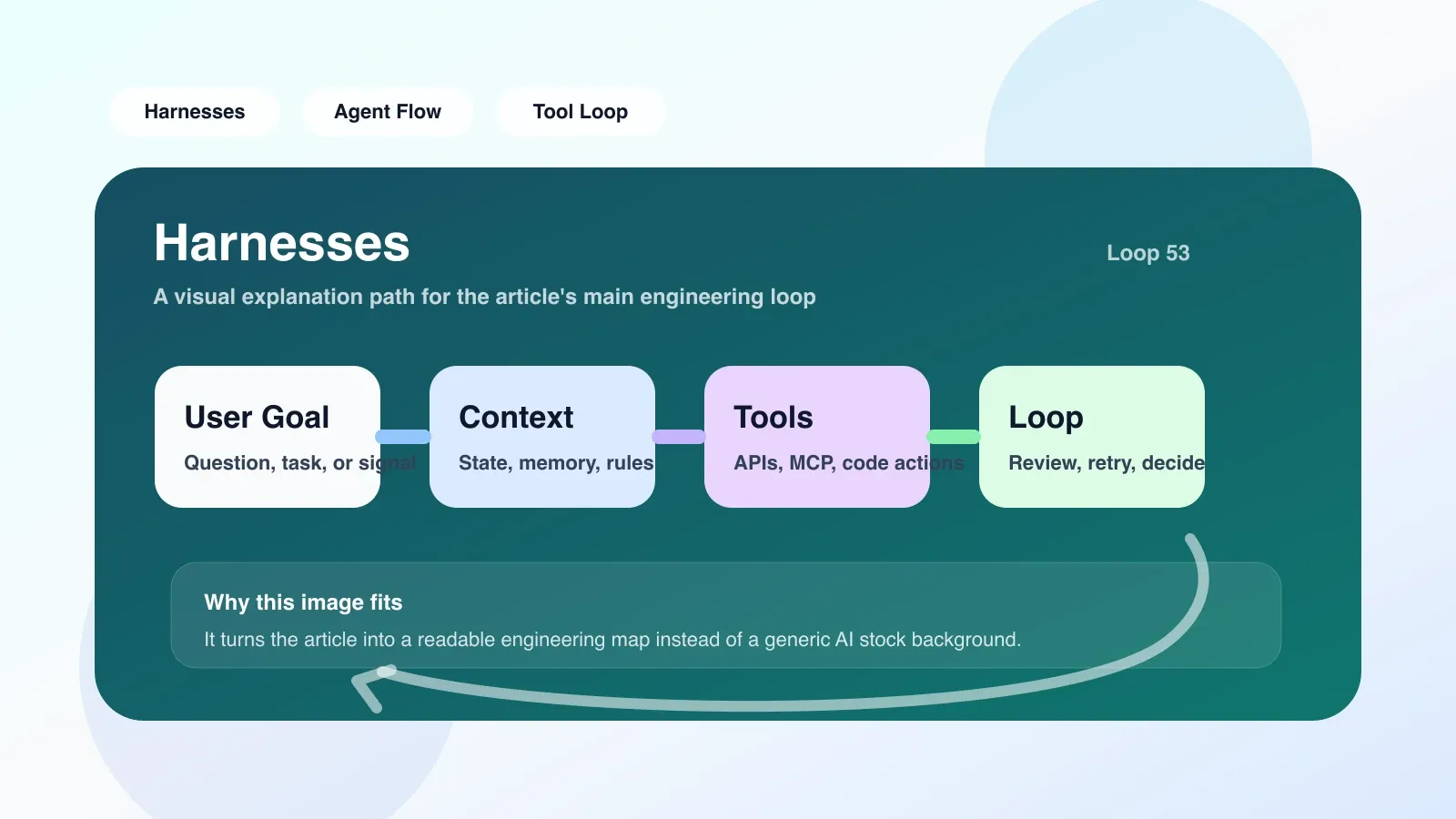
The Most Prone Areas for Failure and Misunderstanding
1. Over-reliance on Harnesses to fix AI quality issues
The most common misconception is to treat Harnesses as a universal quality gate. In practice, Harnesses can only verify known constraints (input/output formats, boundary conditions) and cannot catch logical errors, business semantic errors, or unexpected side effects. If the code generated by AI is logically correct but performs poorly, Harnesses will not automatically detect it. It is only useful when you have designed corresponding test cases.
Case: The team tested a sorting algorithm generated by AI using Harnesses. All tests passed, but the algorithm complexity was found to be O(n²) online, causing the system to time out. Harnesses has no performance claims and therefore fails.
2. Fixtures and simulations are overly simplified
The effectiveness of Harnesses depends on the realism of the test fixtures. If the simulated data is too simple (always testing string handlers with "hello world"), AI code will expose problems in real-world scenarios.
3. Ignoring the maintenance costs of Harnesses themselves
Writing harnesses and fixtures requires time investment. If AI code is updated frequently (for example, multiple times daily), Harnesses also needs to adjust in sync. Teams easily fall into the cycle of "writing tests" and "maintaining tests," which actually slows down iteration speed.
Backup Plan in Case of Failure:
If Harnesses overhead is too high, consider the following:
- Lightweight Downgrading: Use Harnesses only for high-risk scenarios (such as database writes, payment logic); for others, use traditional unit testing.
- Human Review Point: Triggers a manual code review when Harnesses fails, rather than automatically retrying.
- Sandbox execution: Instead of Harnesses, run AI code directly in production/pre-release environments, but with blue-green deployment and rollback mechanisms as a backup.
If you want to implement it now, what should you do as the first step?
-
Specify what you want Harnesses to do: List the first AI code snippet (such as a function, an interface) for key test scenarios: input/output format, boundary values, exception paths.
-
Select or build minimal harnesses: You can directly use existing testing frameworks (such as pytest, Jest) plus simulation libraries (such as unittest.mock) as the base harnesses. Key steps:
- Write a basic fixture, load AI code, and inject a mock object.
- Write a statement to check whether the output of the AI code meets expectations.
- Print the execution results into the log.
-
Run and record failure: Let the AI code run once in Harnesses to see if it passes. If it fails, analyze the cause (AI whether it is a problem with the code itself or with the test configuration).
-
Iterative Optimization: Based on the results of the first run, adjust the context injection method or test assertions to gradually increase test coverage.
Practical Examples (Using Python as an example):
# simple_harness.py
import subprocess
# 假设 AI 生成了一段代码 ai_generated.py
def test_ai_code():
    result = subprocess.run(['python', 'ai_generated.py'], capture_output=True, text=True)
    assert result.returncode == 0, f"AI code failed with error: {result.stderr}"
    assert "SUCCESS" in result.stdout
This is just the simplest version. Production-grade Harnesses also require context loading, simulation, and retry logic.
Next step: Systematic learning
If you want to integrate Harnesses into your team's workflow and master a complete AI coding quality control system, the in-house AI Advanced Programming Course] covers in-depth topics such as Harnesses design, fixture management, and continuous integration. Through real project cases, the course helps you build a production-grade AI code validation pipeline from scratch.
Harnesses is a powerful tool in the AI coding workflow but requires careful use. Understanding its boundaries and costs is more important than blindly applying it.
No comments yet. Be the first to share your thoughts.