
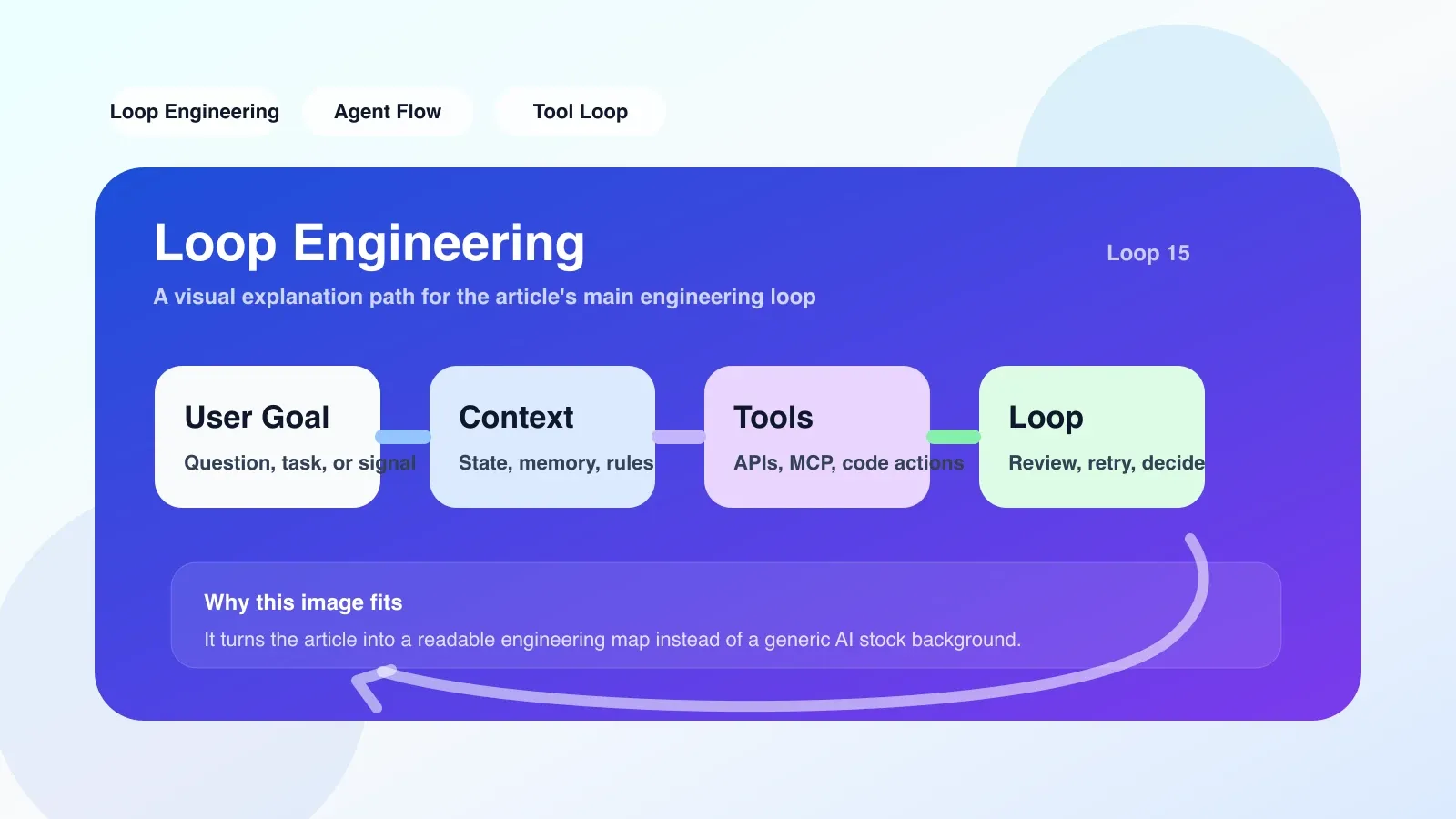
What you lack is not the concept of Agent, but the ability to retry loops
When most developers first come into contact with Agent, their attention is drawn to the fact that it can think for itself. But after actually writing an Agent that can run stably, you will find that the core capability is not the prompt skill, but the control of retry, fallback, and context loops.
Loop Engineering is not a new framework in essence. It is a set of methods that turn "multiple calls + error handling + status transfer" into an engineering paradigm. The capability shortcomings it fills are exactly the key leap for ordinary developers from writing API interfaces to writing autonomous systems:
- Structured Loop: It’s not just while(true), but each loop must have clear boundaries for observation, decision-making, and action.
- Controllable Failure: Agents will definitely go wrong, but Loop Engineering teaches you how to mark, retry, and degrade within a loop instead of crashing directly.
- Context Management: How to update the context after each cycle to avoid context expansion or loss is fundamental to Agent stability.
These abilities are almost never taught in traditional development. When writing a REST API, if a request fails, an exception can be thrown to allow the client to retry; but the Agent is a system that continuously calls, and must handle the failure by itself, otherwise the entire process will be stuck.
The two easiest things to overestimate and underestimate in transformation
The overrated part: the Agent framework itself
Many developers think that they can write Agent after learning LangChain or CrewAI. In fact, these frameworks abstract the underlying loop, but once a problem occurs, you still need to understand Loop Engineering to debug it.
I have seen a team use AutoGPT as a research agent, but because the retry policy was written too aggressively, it retried 10 times in a row when an API returned 429, directly consuming the monthly quota. If they had mastered Loop Engineering's retry strategy (exponential backoff + maximum number of retries) as a basic skill, they wouldn't have been so reckless.
Underrated: How difficult it is to debug a real loop
When you write the first Agent with Loop Engineering, the most painful thing is not writing code, but log analysis. Each cycle may involve multiple internal calls, with external API responses and intermediate state changes included. Once an infinite loop occurs or the output does not meet expectations, you will be faced with nested log lines.
Let’s take a specific scenario: You design a code review agent that loops through each round to read PR diff, generate comments, check whether comments are duplicates, and decide whether to continue. If the code forgets to clear the status of the previous round before generating comments, the Agent will output "This code has potential bugs, optimization is recommended" in the second round, and then repeat the same comment in the third round - it is not a model problem, but the context has not been cleared.
This kind of problem can only be quickly located through the trace capability of Loop Engineering. If an ordinary developer directly gets started with a complex Agent without doing a small exercise first, the troubleshooting time will be more than three times the writing time.
I would suggest you start with this real exercise
There is no need to write complex multi-Agent systems. Start with the simplest "Log Analysis Agent":
- Read a 500-line server log (can be a real log from the project).
- Read 50 lines in each round to determine whether there is an error pattern.
- If there are any, extract the error rows and decide if further analysis is required or if the report should be output directly.
- If not, skip these 50 rows and continue with the next batch.
- Set max_iterations=10 and stop after timeout.
- Output status to the terminal in each round to form retry logs.
This exercise lets you personally encounter the three core nodes of Loop Engineering: Loop Boundary (whether all lines have been read), Error Handling (degradation when log reading fails or model parsing errors occur), State Transfer (how the summary of the previous round affects the next round of decisions).
You can implement a simulation loop in the terminal and use print to output the key variables of each round. When you find that a certain cycle suddenly gets stuck, or the same content is output repeatedly, you have personally experienced the core difficulty of Agent engineering - and this is the real starting point from ordinary development to Agent engineering.
The most common ways to fail in practice
Failure is not a bad thing, but here are the typical patterns of exercise failure that you’d better know ahead of time:
- The loop has no exit condition: only while True is written, and there is no judgment on whether to terminate based on the status or round. The result is that the program runs indefinitely until you manually kill it. Solution: Always set
max_iterationsand check the termination conditions, such as log processing or no valid output for 3 consecutive rounds. - Error handling all-throw exception: Once the model call fails (especially API timeout), the system crashes directly. Actually you should catch the exception, log the round and error, and then choose to skip the round or try again. Once this logic is missing, the Agent will be unavailable in the production environment.
- Context variable overwriting: The same variable name is mistakenly shared in multiple rounds, causing the data in the previous round to be overwritten. For example, use
contextto store the output of this round and the historical status at the same time. As a result, the history will be washed away. Best practice is to use a separate history list.
When should you upgrade to systematic learning?
If you have been able to independently write the above log analysis Agent and have a basic feel for retry strategy and context management, but still feel:
- Don’t know how to design a multi-Agent collaboration loop
- I encountered the problem of Context window exceeding the limit and I don’t know how to compress it.
- Want to use MCP integration but not sure how to adapt the loop
At this time, it means that you have encountered a gap in the knowledge system. Loop Engineering's single exercise can help you get started, but to truly become an Agent engineer, you need to systematically understand advanced modes such as tool invocation, memory management, and planning loops. High-quality original paid articles and AI advanced programming courses can provide this in-depth content, instead of patching it together yourself.
If you've come this far, the next step is to expand the practice project at hand into a real production-level Agent - at this point it is recommended to invest in a systematic path instead of continuing to waste time in trial and error.
No comments yet. Be the first to share your thoughts.