
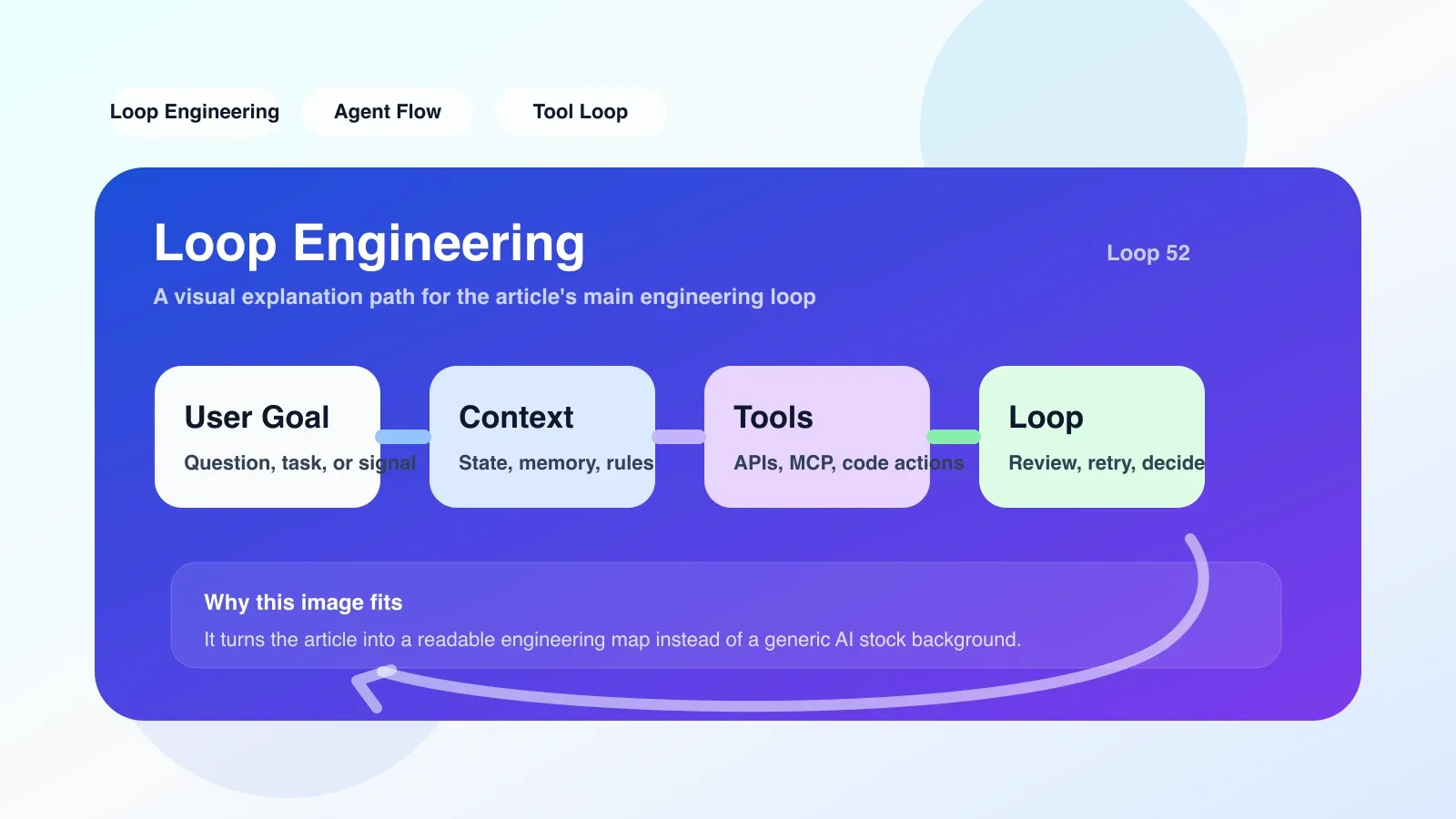
Why Loop Engineering is worth paying attention to now
AI Loops are everywhere in Agent workflows: API calls fail and require retrying, incomplete model answers require follow-up, external tools timeout require reconnection. Traditional programming uses simple and straightforward loop logic, but in Agent workflows, every step has non-deterministic outputs (models may deviate, tools may return unexpected data), making loop boundaries and termination conditions fragile.
Loop Engineering This engineering approach emerged precisely to address this "Agent-level cyclic control." It is not a new technology but an engineering practice that combines existing modes such as retry, termination, and state recovery into a set suitable for AI scenarios. If you are developing or maintaining Agent applications, sooner or later you will face the problem of runaway loops.
What problems does it solve in real engineering processes?
Let's look at a real-world scenario: you set up an agent for code generation, which, after understanding the requirements, calls multiple tools (searching documents, reading files, generating code, running tests). When a test fails, the Agent reanalyzes the error log and adjusts the code. If there is no Loop Engineering, you might write a simple while loop to set the maximum number of retries required. But soon you'll discover:
- After the number of tries is full, the Agent delivers the failed result, with no intermediate state to recover.
- The code generated by two consecutive retries yields almost the same result, wasting time and tokens.
- The internal logs of the loop are chaotic, and you can't pinpoint exactly how many tries led to the final result.
Loop Engineering's core contribution is the introduction of structured loop control:
- State Persistence: The input, output, and decision reasons for each loop are recorded in external state storage (such as databases or JSON files), facilitating debugging and rollback.
- Avoidance and Convergence Strategies: When multiple consecutive retries yield similar outputs, proactively switch strategies (such as reducing the search range or switching to simpler prompts) to avoid idling in dead ends.
- Termination Condition Detection: Not only "maximum number of attempts reached," but also "output pattern recognition" (termination after three consecutive repetitions of the same content) and "external signals" (user manual interrupt or related data source shutdown).
In short, Loop Engineering transforms a potentially runaway "infinite loop" into an auditable, testable, and terminable engineering component.
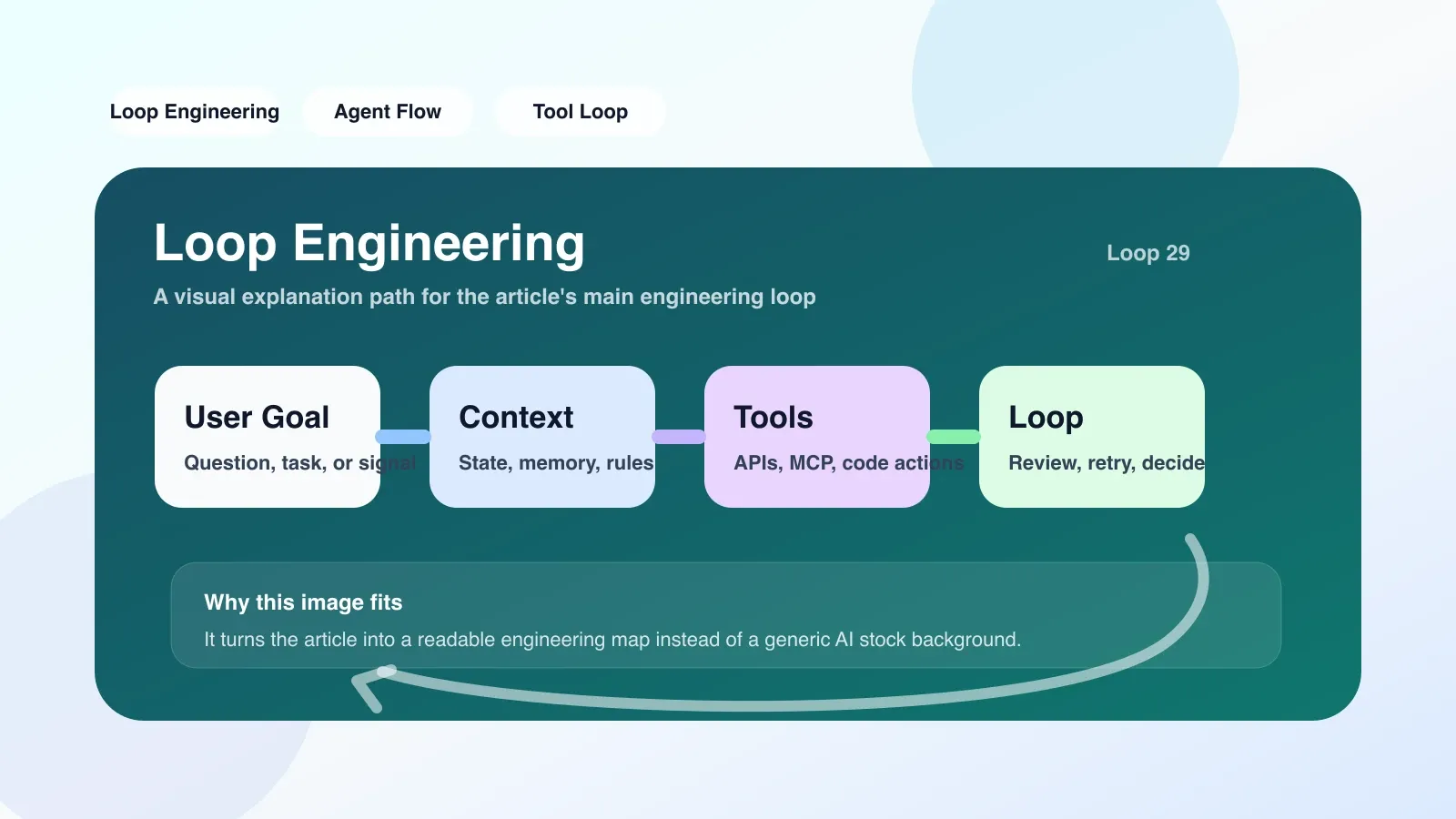
The Most Prone Areas for Failure and Misunderstanding
Failure Point 1: Treating the loop as a regular for/while implementation
The most common mistake is writing the Agent loop into pseudocode like the following:
''for i in range(max_attempts): result = agent.do_task() if is_success(result): break'`
这段代码看起来没问题,但现实情况中:
]is_success[的判断可能不准确(Agent 认为成功,但用户反馈失败)。- `]agent.do_task()' There may be side effects (writing files, sending emails), and the side effect is repeated when retrying.
- No recording of the context for each call, making it difficult to review once it fails.
Failure Point 2: Ignoring State Inflation
Each Agent loop may generate a large amount of intermediate data (model output, tool responses, logs). If there are many loops and long iterations, state storage will expand rapidly, eventually causing the system to collapse. A common consequence is OOM or database write bottlenecks.
Failure Point 3: No simulated loop failure during testing
Many developers only test the successful path once when verifying agents, and Loop Engineering tests must cover:
- After reaching the maximum number of consecutive failures, does the system gracefully degrade?
- If interrupted midway, can you resume from the previous checkpoint after restarting?
- When state storage is abnormal (such as when the database writes out timeout), does the loop not cause data inconsistency?
If you want to implement it now, what should you do as the first step?
The first step is not to write code, but to define the boundaries and state structure of the loop.
The steps are as follows:
- Draw the loop context diagram: Use a piece of paper or a whiteboard (or tools like Miro) to draw the loop's entry, exit, and branch paths. Clarify which steps can be retried and which must be idempotent.
- Design State Record Format: Include at least
attempt_id,input,output,error,timestamp,epoch(current round). It is recommended to use structured JSON storage. - Implement termination detection logic: Start with the simplest "maximum number of times + timeout duration," then add advanced strategies like "output similarity detection."
- Wrap Test Hooks Outside the Loop: Write a test script simulating scenarios such as multiple failures, partial successes, and timeouts to verify that the loop behavior meets expectations.
A reusable reference architecture:
class LoopEngine:
    def __init__(self, max_attempts=3, timeout=30):
        self.state = []
        self.max_attempts = max_attempts
        self.timeout = timeout

    def run(self, task_func, *args, **kwargs):
        for attempt in range(self.max_attempts):
            try:
                result = task_func(*args, **kwargs)
                self.state.append({
                    'attempt': attempt,
                    'status': 'success',
                    'result': result
                })
                return result
            except Exception as e:
                self.state.append({
                    'attempt': attempt,
                    'status': 'failed',
                    'error': str(e)
                })
        raise MaxRetryException(self.state)
This is not the final solution, but it provides state logging and exception throwing, laying a solid foundation for subsequent optimizations (retreat, state recovery).
Where to Go Next: Continue Systematic Learning
Loop Engineering is just one node in the Agent engineer's skill tree. If you want to systematically master Agent design and engineering practices, you need to deeply understand:
- Construction and management of context/in-context
- MCP (Model Context Protocol) integration pattern
- Testing and evaluation (Evaluation) framework
- Architectural evolution from single agents to multi-agent collaboration
These topics are more fully explained in high-quality original paid articles and AI advanced programming courses, suitable for developers who have mastered the basics and want to enter practical applications.
No comments yet. Be the first to share your thoughts.