
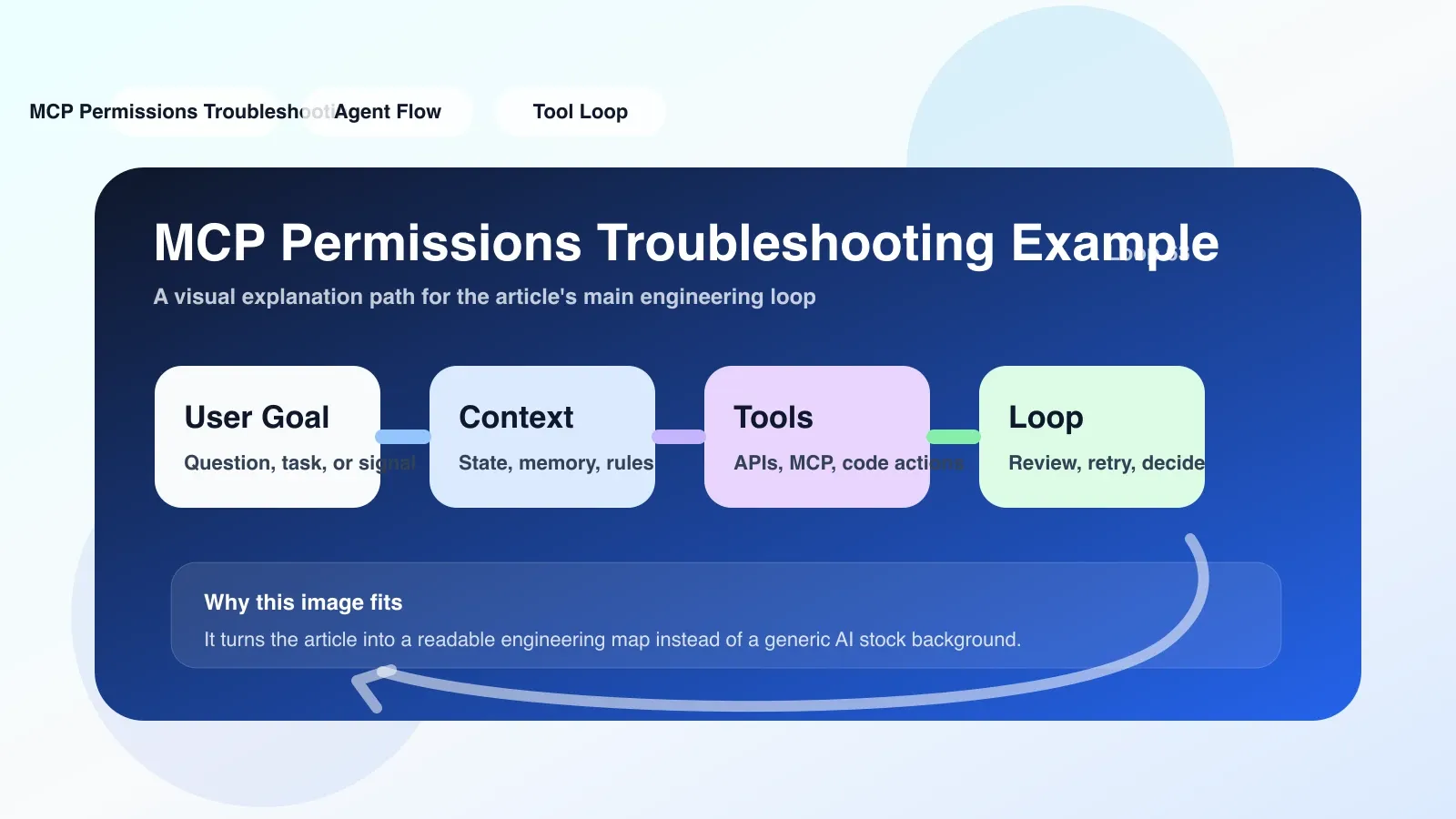
Why are you always struggling with these three options?
Assume a scenario: Your AI coding Agent suddenly generates a permission denial error after modifying the code and cannot read a certain configuration file. You open the terminal and see the error stack pointing to "MCP permissions denied". At this point you have three options:
- MCP Permissions Troubleshooting: Directly locate and repair the permission configuration of the MCP (Model Context Protocol) layer.
- Agent Workflow Audit Log: Look through the audit log of the Agent execution steps and trace the sequence of operations before the error occurred.
- Rollback: Roll back the last snapshot or state version of the Agent.
This is not a multiple-choice question, but a context-based multiple choice question. Choosing the wrong solution can waste time at best, or lose data or introduce new problems at worst. This article uses a real example to run through the three options to help you build your decision-making intuition.
Solution 1: MCP Permissions Troubleshooting Example
When to choose it: Permission errors are clear and reproducible
Suppose your Agent returns 403 when requesting an API, and you suspect that the access control rules of the MCP are misconfigured. The MCP layer is responsible for permission negotiation between the Agent and external tools. Typical faults include:
- Missing scope: For example, the Agent has the right to read the file, but not the right to execute the file.
- Resource path restriction: Only access to
/data/publicis allowed in the MCP configuration, but the Agent tried to write to/data/private. - Rate limit reached: Agent initiated too many requests in a short period of time and was temporarily banned by MCP.
Operation steps
- Locate the source of the error: Check the records with the "MCP_PERMISSION" label in the Agent running log. Usually contains information similar to
MCP Permission denied for tool: execute_file on resource /data/private. - Check MCP configuration file: Find
mcp-config.yamlor the corresponding permission rule file. Confirm whether the Agent identity (such as a service account) has been granted the scope of the required operation. - Temporary permission expansion test: In the development environment, first add wildcard permissions (such as
allow: /data/*) to verify whether the problem is solved. If the problem is solved, shrink it to the minimum necessary permissions. - Apply and verify: Restart the Agent after updating the configuration, reproduce the same request, and confirm that no errors are reported.
Where it is easy to fail
- Missing permission granularity: The MCP permission model may contain multiple layers - tool level, resource level, operation level. After only changing one layer and leaving out the upper layer, the problem remains the same.
- Cache Pollution: Some MCP implementations cache permission decisions. After modifying the configuration, you must clear the cache or restart the process, otherwise the old rules will still take effect.
- Non-permission error: The 403 error may also be a problem with the backend service itself (such as API key expiration), rather than MCP permissions. Changing the configuration hastily may introduce security vulnerabilities.
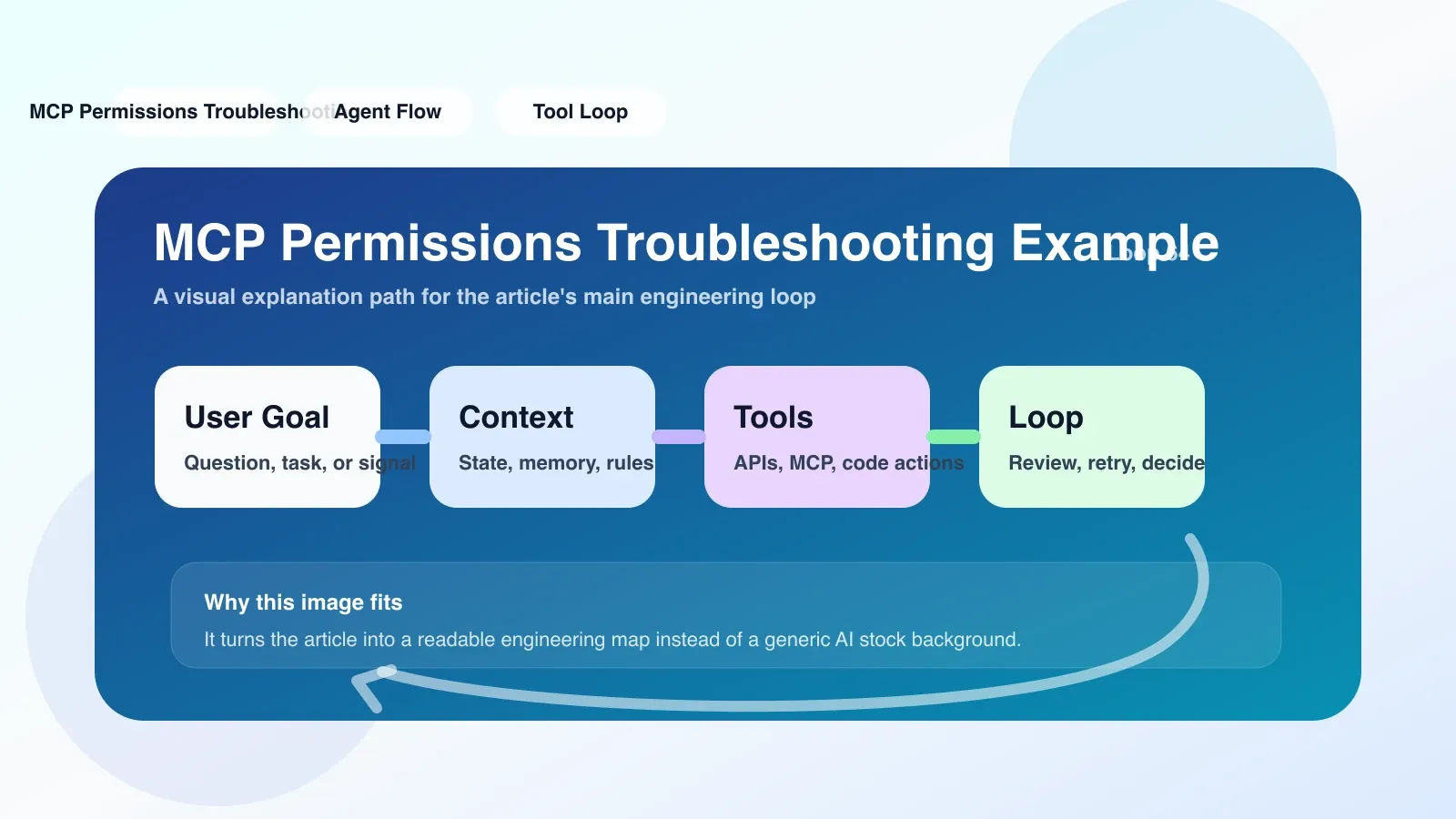
Solution 2: Agent Workflow Audit Log
When to choose it: Requires understanding of the full context in which the error occurred
Agent's decision-making is not executed in a single step. The audit log records the input, output, and status transition of each step. Logs can reveal hidden dependencies when errors "appear out of nowhere."
Operation steps
- Export audit log: Export JSON format logs from the management interface of the Agent framework (such as LangGraph, AutoGen). Make sure to include timestamps, node IDs, input and output snapshots.
- Track status changes: Find the last successful step before the error, and the first failed step. Compare the input differences between the two. For example, the Agent successfully requested the file
/etc/config.jsonin step 5, but failed to request the same file in step 10—it may be that the file permissions were modified in the intermediate step. - Mark suspicious nodes: If the Agent contains loops or conditional branches, the audit log can show which path it took. For example, the error occurred in the
elseblock of the conditional branch, and the code of this block was recently updated. - Reproduce and patch: Based on the log analysis results, modify the Agent workflow (such as adding permission verification steps or adjusting branch logic).
Where it is easy to fail
- Log redundancy: The audit log of a large Agent may contain thousands of steps, and direct reading is extremely inefficient. It is necessary to filter out error-related nodes and abnormal status first.
- Time out of sync: In a distributed agent, the timestamps of multiple working nodes may be inconsistent, leading to chaotic state restoration.
- Missing log: Some Agent frameworks only record key nodes by default, and the input and output of non-critical steps may be lost, making it impossible to trace the complete context.
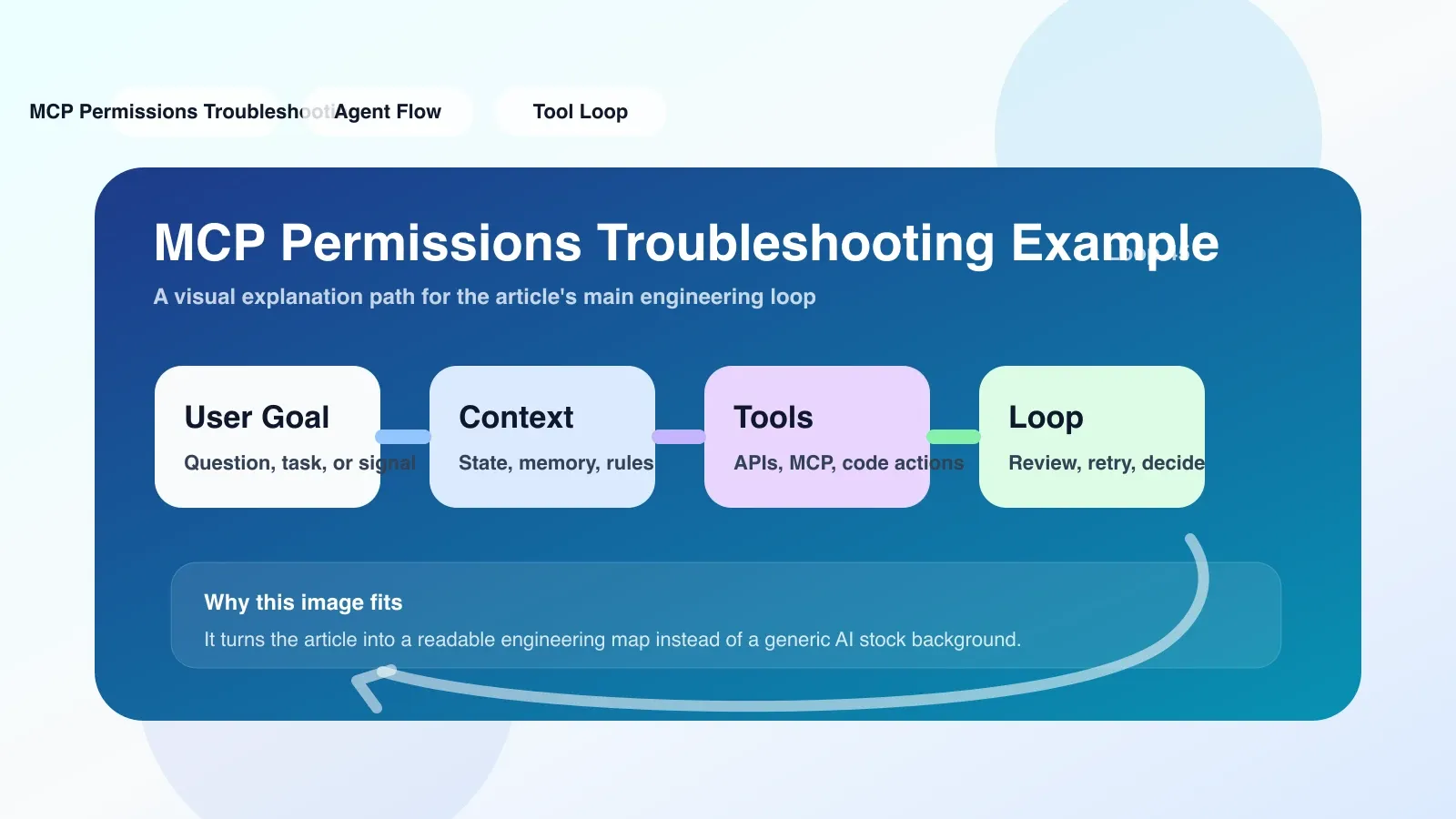
Option 3: Rollback
When to choose it: The error range is wide, the impact is large, and it cannot be quickly located.
When an error causes the Agent to crash continuously or multiple users to be affected, rolling back to a stable version is the fastest way to stop losses. It doesn't solve the underlying problem, but gives you breathing room.
Operation steps
- Confirm rollback point: Agent usually maintains state snapshot or Git Commit. Choose a "before known error" time point. For example, the most recent time when the Agent successfully performed a task.
- Execute rollback: Use the
rollbackcommand of the Agent framework or manually switch versions. Pay attention to rolling back the associated configuration, database schema, and model weights at the same time. - Verify stability: Run a set of smoke tests after rollback to confirm that core functions are restored. If an error is still reported, it means that the problem is earlier than the rollback point, and a more complete rollback or other solutions are required.
- Root Cause Analysis: Do not directly launch the old version after rollback. It is necessary to compare the differences between the two versions and locate the changes that introduced errors.
Where it is easy to fail
- Incomplete rollback: Only the Agent code is rolled back, and the database migration or upstream service dependencies are not rolled back, resulting in version mismatch.
- Data Loss: If the Agent generates critical data (such as user session status), the rollback will lose these incremental data. Need to back up first.
- State Drift: The long-running Agent has a complex state, and logical contradictions may occur after rollback (such as an event that has been processed is triggered again).
Comparison of the three: Which one to choose?
| Dimensions | MCP Permissions Troubleshooting | Agent Workflow Audit Log | Rollback |
|---|---|---|---|
| Applicable scenarios | Specific permission-type errors, reproducible | Unexplained errors, need context | Catastrophic errors, quick stop loss |
| Time Cost | A few minutes to half an hour | 30 minutes to a few hours | A few seconds to a few minutes |
| Risk | Excessive opening of permissions leads to security risks | No direct risk | Data loss, version incompatibility |
| Skills required | MCP configuration knowledge | Log analysis and Agent workflow understanding | Version management and status management |
| Backup plan after failure | Switch to audit log or temporarily expand permissions test | Switch to MCP troubleshooting or rollback | Backup recovery or reconstruction status |
Real scene drill
Suppose your Agent suddenly reports an error during the automated deployment task: MCP Permission denied: cannot execute script /deploy.sh.
- Step 1: Try MCP Troubleshooting. Checking the configuration revealed that the
/deploy.shpath was not in allowed_resources - this was an explicit permissions issue. The problem was solved after modifying the configuration. It takes 5 minutes. - If it fails: The error is still reported after modification. At this time, it is suspected that dynamic splicing of paths causes the actual request paths to be different. Switch to Audit Log, check the resource path actually requested by the Agent, and find that it requests
/deploy-v2.sh. It turns out that the internal logic of Agent uses Git branch name splicing path. Fix Agent logic. - If it still fails: Roll back to the previous stable version, and mark the Agent status of the branch as abnormal.
The easiest trap to step into
- Over-reliance on a certain solution: For example, all errors are tried to be solved by expanding permissions, which ultimately leads to security vulnerabilities.
- Ignore backup: Do not back up the current state before rolling back. Once the rollback point is broken, all data will be lost.
- Log Flood: The audit log is not rolled and cleaned regularly, and the disk is full, causing the Agent to hang up.
How to establish a team-level selection mechanism?
- Define error classification: Divide common errors into permission categories, logic categories, and external dependency categories. Priority is given to MCP troubleshooting for permission types; audit logs are given priority for logical types; and rollback of global errors is given priority.
- Standardized log format: Ensure that all agents output structured logs, including severity level, component identification, and snapshot path.
- Develop rollback SOP: Clarify the rollback process, backup steps, and verification list.
If your team is moving from "manual debugging" to "systematic agent operation and maintenance", the next step is to master more complete agent engineering practices - from permission model design, observability buried points to automated recovery strategies. This knowledge is systematically explained in high-quality original courses.
No comments yet. Be the first to share your thoughts.