
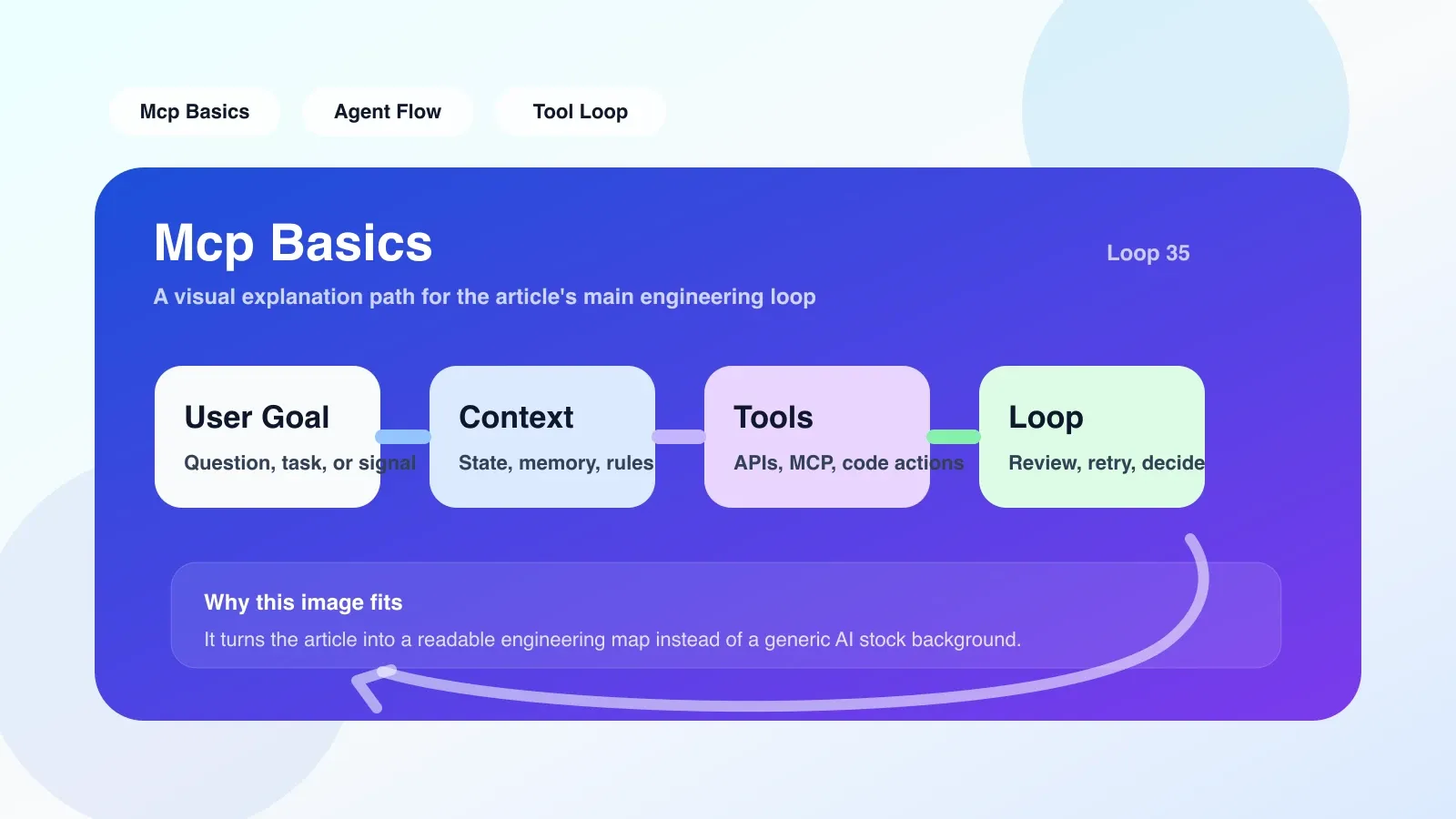
Model Context Protocol: The value of the protocol is not a new term, but a unified tool access layer
When many teams hear the Model Context Protocol for the first time, they will understand it as a new framework that "makes large models smarter". This understanding is wrong.
MCP is more like a layer of standardized interfaces. The core goal is not to improve the capabilities of the model itself, but to unify the connection between the model and external tools, data sources, and local environments. In the past, every time you connected an editor, database, file system, or command line tool, you might have to write a set of customized adaptations; with the unified protocol, the client and server can exchange "what tools are there, how to call them, and what results are returned" according to the same set of rules.
Why this matter is worth paying attention to: Because AI coding, Agent workflow, context injection, and tool invocation have moved from the demonstration stage to the daily engineering stage. As long as you're doing "let the model actually do the job", sooner or later the tool access layer will become a bottleneck.
Purpose of the agreement: What exactly is MCP solving?
MCP does not solve "the model doesn't answer the question", but the following engineering problems:
- The same model product needs to be connected to multiple tools and data sources, resulting in too much repeated development.
- The same set of tool capabilities wants to be reused by multiple clients, but lacks a unified exposure method.
- When switching between models, clients, or workflow expansion, the original tool integration is difficult to migrate.
- After more and more tool calls are made, permissions, input and output formats, and observability begin to become confusing.
To put it more directly: MCP attempts to change "tool access" from one-time coupling code to a reusable, replaceable, and enumerable protocol layer.
This is also its most practical value. If your system already has models, prompt words, context assembly and task arrangement, then MCP complements the "standardization of external capability access" rather than replacing these things.
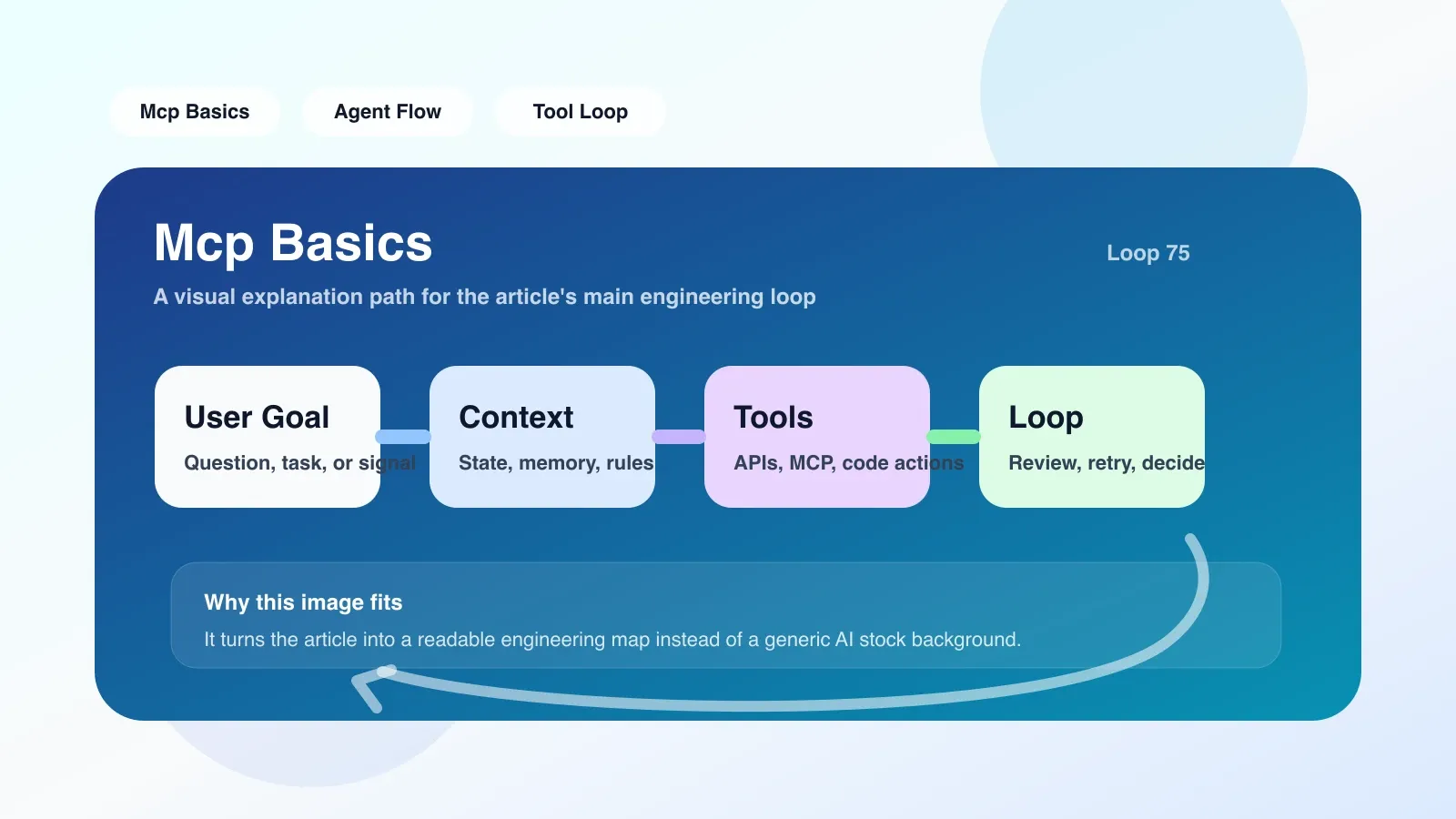
Client and server: who is responsible for what
To understand MCP, don’t automatically associate “server” with traditional Web API.
In the context of MCP, we can first understand it from an engineering perspective:
- Client: The side that initiates the request, usually a chat application, IDE, Agent host, desktop application, or a running environment with a model interactive interface.
- Server side: The side that exposes capabilities is responsible for declaring which tools, resources or operation entrances it has, and responding to calls according to the protocol.
A common scenario is this:
- Your AI coding client wants the model to read the project file, search the code, and perform some controlled operation.
- The client does not directly hardcode all capabilities into itself.
- It uses MCP to discover what tools are provided by a server.
- The model or upper-level orchestration logic decides whether to call these tools.
- After execution, the server returns the structured results to the client, and then continues subsequent reasoning or display.
The most critical thing here is not who is "bigger" or "more central", but who is responsible for experience and ability.
- The client prefers the interaction layer and orchestration layer.
- The server side prefers the capability exposure layer and execution layer.
Therefore, MCP is not "yet another model API" but "a unified protocol interface for model peripheral capabilities".
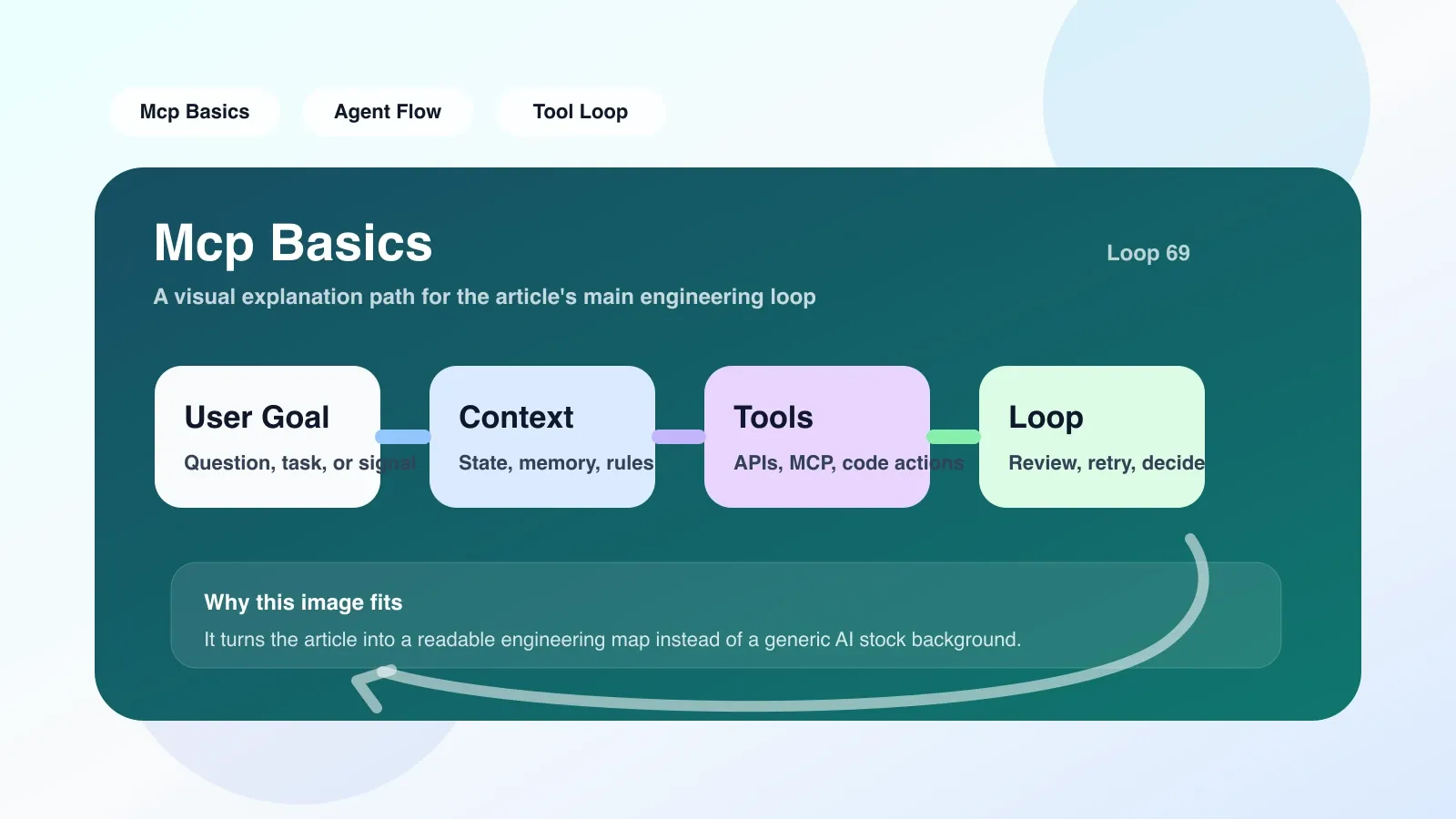
Why it matters now
If you only look at the concept, MCP can easily be regarded as another protocol wrapper. But it matters now for four main practical reasons.
1. Tool calling has changed from a bonus item to a basic ability
The value of simple question and answer is declining. What is really useful is to let the model read files, check data, and adjust commands, operating systems, or business tools. With too many tools and no unified interface, maintenance costs will rise rapidly.
2. Agent workflow begins to require migration
Many teams don't use just one model, and they don't just use one client. The tool chain that works well in client A today may need to be moved to environment B tomorrow. Protocolization can reduce the loss of "rewriting everything when you change the shell".
3. Context engineering increasingly relies on external systems
Context is no longer just prompt words and historical messages. Code repositories, documents, databases, logs, and task status may all become part of the model context. The value of MCP is to unify the access methods of these external sources and prevent each source from becoming an independent island.
4. The team starts to care about governance, not just running through the demo
Once in production, the team immediately encountered these problems:
- Which tools can be called?
- What are the calling boundaries?
- How to roll back after failure?
- Is the response stable, monitorable, and auditable?
MCP itself is not equivalent to a governance plan, but it at least provides a unified hanging point for governance. Without a protocol layer, governance is often scattered among ad hoc adapters.
Typical link: How to call a MCP tool
From the perspective of the project link, a typical call can be understood as the following 6 steps:
- The client connects to the MCP server.
- The server declares available capabilities, such as tools, resources or operation portals.
- The client exposes these capabilities to the upper model runtime or Agent orchestration layer.
- When the model answers the task, it determines whether it needs to call a certain tool.
- The client sends the call request to the corresponding server according to the protocol.
- The server executes and returns the structured result, and the client merges the result back into the subsequent context.
The most easily overlooked point in this link is: MCP is responsible for "how to connect, how to adjust, and how to return", but not "when is the most reasonable time to adjust".
The latter still depends on your workflow design, including:
- Tool selection strategy
- Prompt word constraints
- Failure retry logic
- Manual confirmation of nodes
- Security restrictions
Therefore, MCP can make tool access more standard, but it will not automatically make the Agent more reliable. The protocol layer and the decision-making layer are not the same thing.
The actual value of MCP: three direct benefits brought by the unified layer
Reduce repeated access costs
If you manage multiple tool portals, the biggest benefit of a unified protocol is less repetitive glue code. Especially when the same batch of capabilities need to be consumed by multiple AI clients, the protocol layer will be more economical than connecting each client individually.
Reduce migration costs
When a team moves from one model platform to another, or from chat-based products to IDE/Agent products, if the tool layer has been standardized, the migration difficulty will be significantly reduced.
Improve the efficiency of ability combination
After unified exposure, tools are no longer private integrations, but more like composable capability modules. This is more suitable for subsequent workflow orchestration, permission control and unified observation.
Most common misunderstandings
Misunderstanding 1: With MCP, the Agent will naturally be stronger
No. MCP only addresses access standardization, but does not address core issues such as task disassembly quality, prompt word design, context compression, and tool selection strategies.
If your Agent does not know when to read files, when to call commands, and when to stop for confirmation, accessing MCP will not automatically fix these defects.
Misconception 2: MCP can replace all API integrations
Not right either. Many systems will still retain direct API calls, especially scenarios with high performance, strong constraints, low latency, or very clear security boundaries.
MCP is more suitable for those capabilities that "require unified access, multi-party reuse, and model interaction" and may not be suitable for all underlying system calls.
Misunderstanding 3: As long as the protocols are unified, integration will no longer be complicated.
Protocol unification can only reduce part of the complexity, and the remaining complexity still exists:
- Whether the tool is properly designed
- Whether the returned results are structured enough
- Whether the error is recoverable
- Whether permissions are controllable
- Is the response speed acceptable?
If these are not handled well, MCP will only wrap a poor tool interface into a "standardized poor interface".
Misunderstanding 4: MCP focuses on new concepts
On the contrary, MCP deserves attention not because it is new, but because it brings previously scattered, private, and duplicated tool access methods to the same layer for processing. The real value is in engineering consistency, not in noun popularity.
Where to fail: The easiest trap to step on
If you plan to use MCP in a real project, the most likely failure point is usually not "cannot connect", but "connected but difficult to use".
Treat the protocol layer as the product capability itself
The protocol is just the transport layer, not the capability itself. A tool with a confusing design, ambiguous naming, and unstable input and output will not become a good tool even if MCP is installed.
Ignore permissions and execution boundaries
As long as the tool involves the file system, command execution, and internal data access, unclear boundaries will cause problems. You need to specify:
- Which operations are allowed to be automated
- Which operations must be manually confirmed
- Which resources can only be accessed read-only
- After which calls must fail, the link must be stopped
The result format is unstable
When a model consumes tool results, the biggest fear is that the returned content may be long or short, the fields may be unstable, and the error information may be undecidable. The unified protocol does not mean that the results are naturally available. The server still has to design the output for machine consumption.
Over-instrumentation
Not everything is worth walking MCP. For very simple, very fixed capabilities that are used only within a single system, direct function calls or direct APIs may be simpler.
If everything is made MCP server-side in order to "look advanced", the maintenance cost may be higher.
Fallback plan in case of failure
MCP is not the only answer, there are three common alternative paths when it fails.
1. Direct API integration
It is suitable for situations where there are few tools, the call chain is stable, and the caller is single. The advantage is that implementation is direct, performance and control are usually better; the disadvantage is that migration and reuse capabilities are weak.
2. Private tool layer within the application
If you only serve one product, one client, and one specific scenario, it is often faster to encapsulate private tools within the application first. After the capability boundaries are stabilized, you can then decide whether to make them a protocol.
3. Semi-protocol solution
Some teams will first unify the tool definition, input parameters, output parameters, and error structure, but are not in a hurry to fully introduce MCP. This method is suitable for the transition period. It can tidy up the chaotic interfaces first, and then decide whether to adopt a more standard access layer.
The judgment criteria are simple:
- If you are faced with multi-client reuse, multi-tool expansion, or future migration, MCP is more worthy of investment.
- If you only implement a single function, it is usually more pragmatic to use a lighter solution first.
Who should give priority to MCP
These are the people who deserve to be understood as quickly as possible MCP:
- Developers who are doing AI coding, Agent, Copilot, and workflow automation
- People who need to connect files, databases, documents, command lines and other capabilities to the model
- Teams evaluating multi-model, multi-client, multi-tool collaboration architectures
- Engineers who want to move from "knowing how to tune model APIs" to "knowing how to build Agent engineering systems"
If you are currently only doing plain text Q&A, simple customer service or single interface calls, MCP is important, but may not be the current top priority.
When not to rush MCP
In the following situations, it is not recommended to use MCP as the first step:
- Demand is not yet stable, and tool boundaries are changing every day
- There is only one fixed tool and it will not be reused
- The team has not yet solved the more basic issues of prompt words, evaluation, retries, and manual takeover.
- The current bottleneck is not the access chaos, but the mission success rate itself is too low
Run through the core workflow first, and then consider whether the protocol layer needs to be unified. This is usually more stable than implementing complete abstraction from the beginning.
How to judge whether to invest in the next step?
You can use three questions to make a quick judgment:
- Are you already writing duplicate access code for multiple tools?
- Do you expect the same tools to be reused by multiple clients or agents?
- Have you already felt the confusion in migration, governance, and observation?
If the answer to more than two of these three questions is "yes", MCP is most likely not a conceptual reserve, but an actual engineering problem.
If what you want to do next is not just "call the model", but actually put context, tool use, loop, and agent workflow into engineering practice, then understanding MCP is just the starting point. The harder part is connecting the protocol layers, task orchestration, assessment and security boundaries into a continuously evolving system.
No comments yet. Be the first to share your thoughts.