
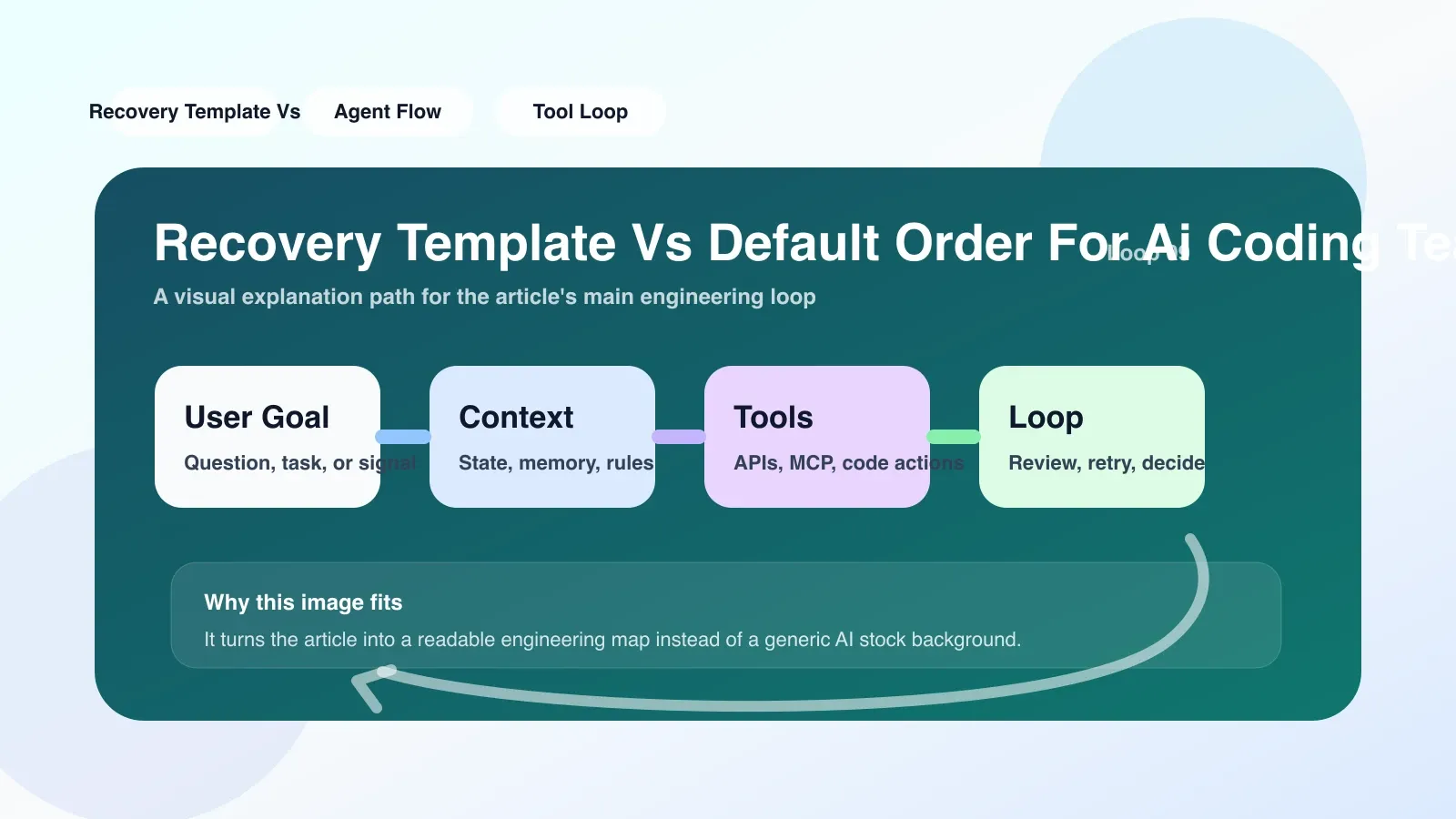
What are Recovery Template and Default Order?
In the AI programming workflow, teams often need to control the agent's reply sequence, especially in parallel calls, multi-step backtracking, or state recovery scenarios. Recovery template means that when a certain generation fails or needs to be regenerated, the system only replaces the affected part according to the predefined template, while retaining other contexts. Default order is to generate responses in strict accordance with the order in which the requests are issued. Even if there is a failure in the middle, it will wait or skip, and the order of the unaffected parts will not be changed.
Simply put, the recovery template is "partial retry" and the default order is "overall queuing".
Applicable scenarios: When to choose which one?
Recovery Template is suitable for: code review and local repairs
When your AI agent is responsible for code review, you often need to modify a certain line or function without affecting other reviewed code. For example, if the team uses AI to review the PR and finds a bug in a certain function, you use the recovery template to let the agent only regenerate recommendations for that function, while retaining other comments and context. This allows for quick fixes without causing the agent to re-output everything.
Practical example:
- You generated 5 comments on the PR using AI. The 3rd comment has an incorrect fix suggestion.
- Use recovery template: Replace comment 3 with the correct version, leave the other 4 unchanged.
- Use default order: You need to re-execute the entire review from the beginning, or skip it manually, easily losing work.
Default Order is suitable for: processes with high consistency requirements
When your team needs to execute tasks in a strict order, such as an automated CI/CD pipeline, a step-by-step deployment script, or a strict process of multi-agent collaboration, default order can ensure the reproducibility of the results. For example, AI sequentially generates test cases, then runs, then reports. If one of the steps fails, the default order will be explicitly interrupted to facilitate you to locate the problem, instead of "silently" hiding local errors like the recovery template.
Real scenario: When a team used AI to generate full migration code, they used the recovery template to try to quickly retry the failed steps. As a result, implicit bugs appeared in the migrated code due to inconsistent context. Later, I switched to default order. Although it was slow, every failure could be traced back to the exact steps.
The easiest trap to step into
Misunderstanding 1: Blindly pursuing speed and using recovery template
In order to make AI respond faster, some teams use recovery templates in all scenarios. But recovery template relies on the accuracy of the template and the completeness of the context. If the template definition is not rigorous (for example, the replacement range is too large or too small), it is easy to have "partially correct but overall confusing" situations. For example, a function signature is changed, but the recovery template only replaces the function body, resulting in a signature mismatch.
Misunderstanding 2: Thinking that default order must be more stable
Default order is executed sequentially, but once a long wait or hang occurs, all subsequent requests will be blocked. When processing a large number of small tasks in parallel, the default order may become a bottleneck.
Myth 3: Ignoring contextual consistency
Both strategies depend on context. If you modify external states (such as databases and environment variables) during execution, the recovery template cannot sense these changes, causing the generated results to be inconsistent with expectations.
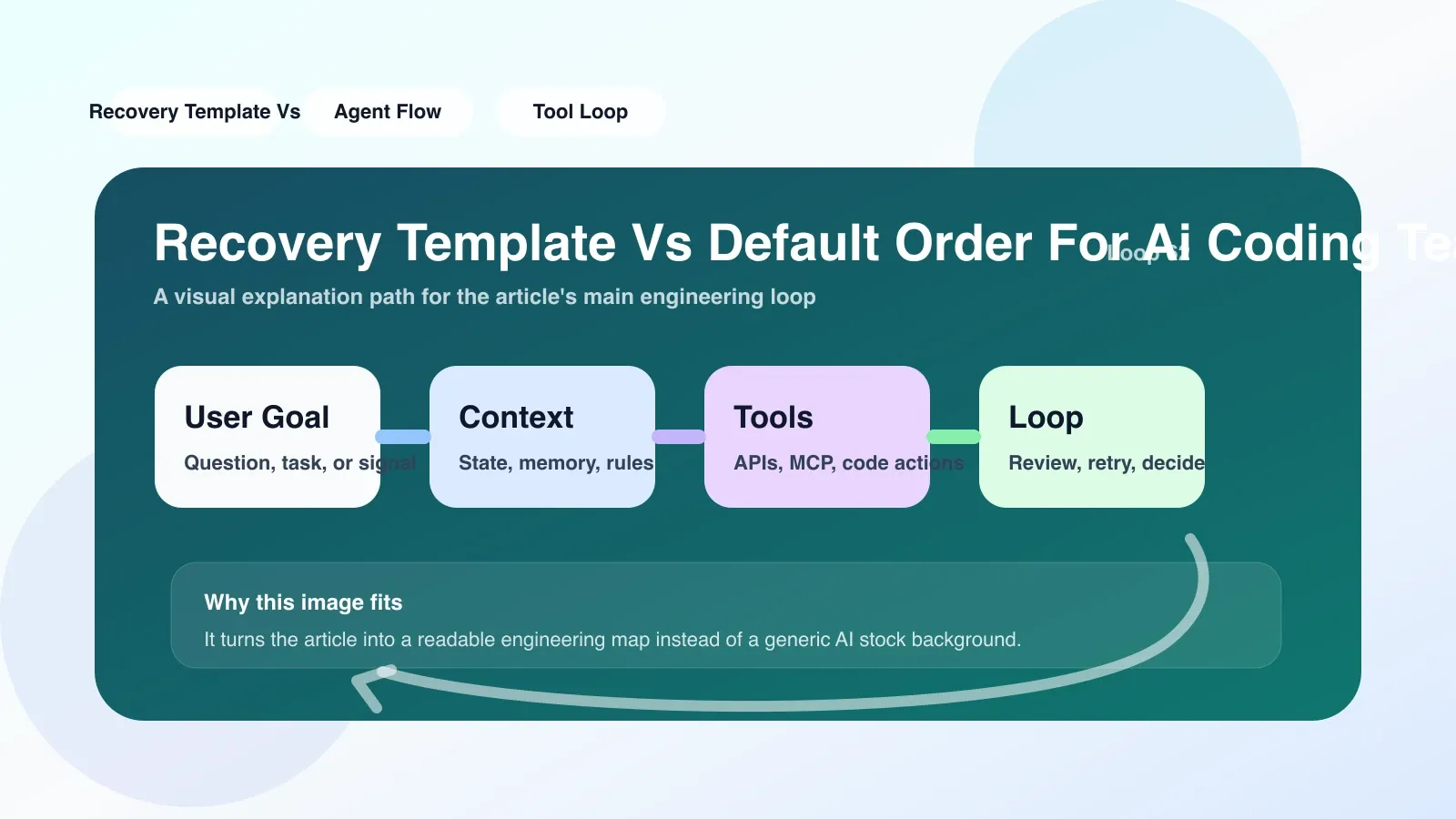
Specific comparison decision table
| Comparison Dimensions | Recovery Template | Default Order |
|---|---|---|
| Core applicable scenarios | Partial retry, code review, repair | Strict sequence, pipeline, reproducibility |
| Execution speed | Fast (only retry part) | Slow (execute in sequence) |
| Consistency and traceability | Low (may hide intermediate errors) | High (observable at every step) |
| Implementation complexity | High (needs to design templates and patching strategies) | Low (can be arranged in sequence) |
| Scope of failure | Local (can be repaired individually) | Global (may block follow-up) |
Fallback plan in case of failure
When the recovery template causes an error due to context inconsistency, return to default order and re-execute the entire process. Specifically: record the initial state of the request (including all inputs and environment snapshots), and then resend the request in the original order without skipping any steps. This ensures reproducible results.
If the default order fails due to a long hang, you can use the timeout + retry template, that is, set the recovery template for a single step of the timeout to only retry the step, but still maintain the order of other steps.
Migration Checklist
If your team is switching from default order to recovery template (or vice versa), the following checklist can help you avoid common pitfalls:
- Make it clear which steps have strict order dependencies (default order must be used)
- defines the scope of recovery template (what to replace, what to keep)
- Ensure context snapshot is unchanged before retrying
- Set the log to record the template and actual replacement content of each retry
- Grayscale testing: first use recovery template for low-risk tasks (such as code formatting), and then gradually expand
Next action
After understanding these two strategies, it is recommended to first draw a "risk ladder" in your AI workflow, divide the tasks into two categories according to failure tolerance and sequence dependency, and apply different strategies respectively. Then start with a small-scale pilot and gradually optimize.
No comments yet. Be the first to share your thoughts.