
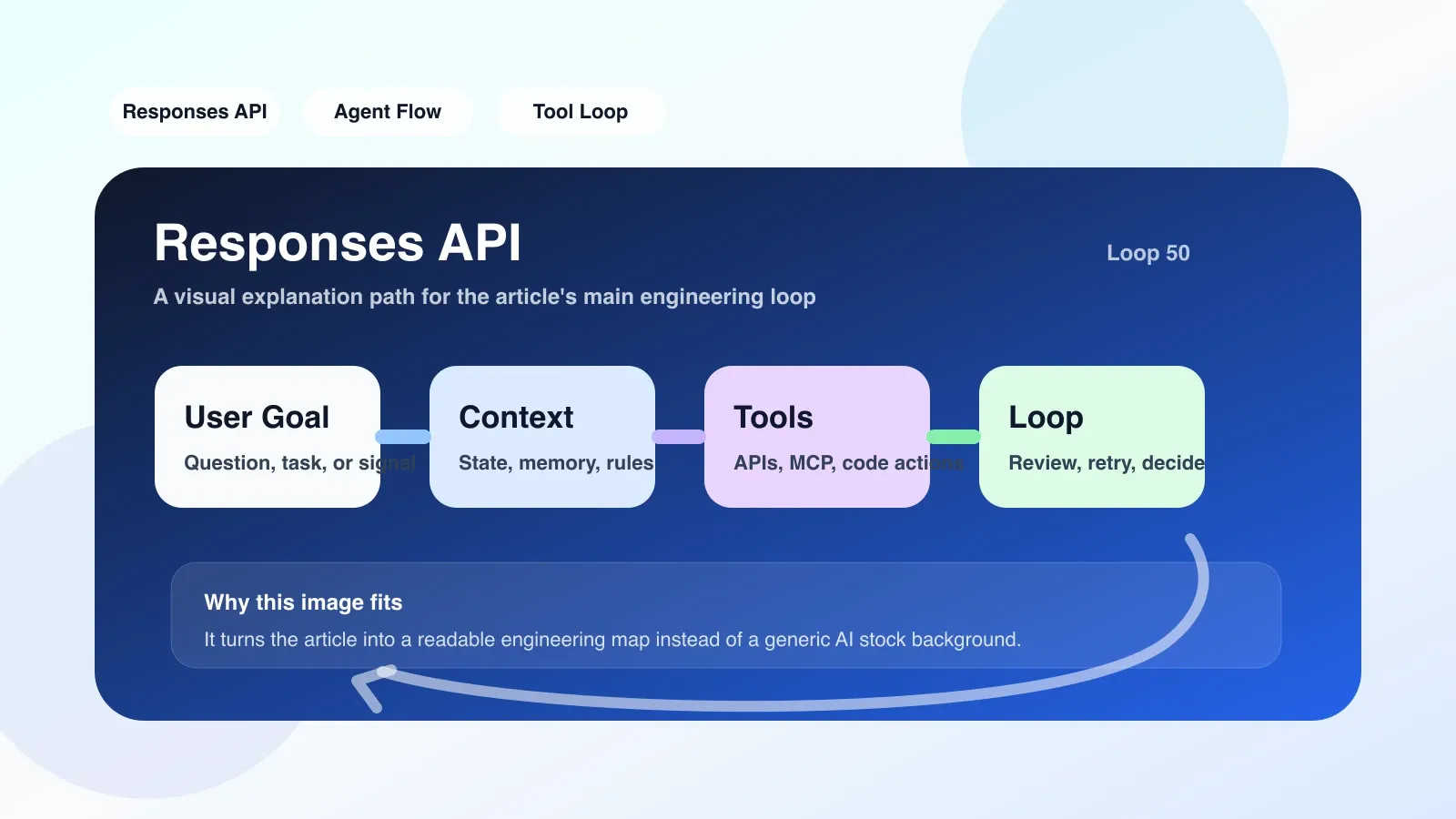
The fundamental difference between the two APIs: state management vs stateless reasoning
Responses API and Chat Completions API play different roles in the Agent system, but they are often confused because the naming of OpenAI makes it easy for people to think that "Responses" is just a new version of "Chat Completions". In fact, Responses API is a stateful management layer that is responsible for maintaining conversation history, managing tool call results, and handling state switching of multiple rounds of interactions. The Chat Completions API is a stateless inference endpoint, each request is independent and does not retain context.
In other words, Chat Completions is like a function call: you type prompt and it outputs completion. Responses API is like a session controller: it receives the user's intention, decides whether to call the tool, pass the result, and track the context until the task is completed or interrupted.
Real scene selection: What kind of Agent are you?
Suppose you are building a Customer Service Agent: The user may ask multiple questions in succession, and the Agent needs to remember the order number, user name and question history mentioned previously. At this time you must use Responses API (or similar managed state framework), because it automatically manages the session ID and context window, and you do not need to splice historical messages yourself. If you use Chat Completions, you have to manually transfer the entire conversation history every time, which is not only troublesome, but also prone to losing early context due to token exceeding the limit.
Another scenario: You just use LLM to do data classification or simple translation, input a piece of text, and output a result. This kind of task does not require multiple rounds of interaction and does not require tool calls. Chat Completions is fully qualified, and the response is faster and the cost is lower.
The third typical scenario: Content generation workflow, such as writing a blog. While it may require invoking search or database tools, RAG typically involves multiple single-round calls, generated directly after each retrieval from the vector library, without the need to maintain state across rounds. In this case, Chat Completions combined with external state management (such as LangGraph's loop mechanism) is more flexible than using Responses API directly, because you can finely control the prompt and tool selection of each step.
The most likely failure method and cost of mismatching
The most common mistake is: Using Chat Completions to do multiple rounds of Agent. For convenience in the early days, developers directly used Chat Completions and loops to implement multiple rounds of conversations. As a result, they encountered two fatal problems:
- Context management is out of control: The complete history must be spelled into the prompt for each cycle, and the token consumption increases linearly with the number of rounds, quickly reaching the upper limit of the model. When truncated, the Agent will forget key information, such as the order number that the user has confirmed, resulting in repeated questions or incorrect operations.
- Tool call status lost: Chat Completions does not support persistent tool call result tracking. For example, the first call obtains weather data, and the second call requires making decisions based on the data. You must manually store the first result into a variable and inject it into the prompt again. Once concurrent requests or interruptions occur, the status will be chaotic.
The price is usually: the development cycle is prolonged by environment debugging and context slicing issues, users complain after launch that "the robot doesn't remember what I said", and ultimately have to rewrite the architecture and switch to Responses API or similar hosting solutions.
Another mismatch in the opposite direction: Use Responses API for pure batch inference. For example, you only need to analyze the sentiment of 1,000 comments at once, and each comment is independent. At this time, the state management function of Responses API is completely wasted, and it also increases latency and call cost (because the session context needs to be initialized every time). Send in bulk with Chat Completions, which is much more efficient.
If the team can only drop one first, which one should be done first?
If the core of your product is a conversational Agent that requires memory and tool orchestration, then Responses API should be implemented first. Its managed state and tool loop allow you to quickly build an Agent that can have a stable conversation and avoid being bogged down by non-core issues such as context management and state synchronization.
If the core of your product is to call LLM for single reasoning (such as classification, translation, summary), or if you already have a mature state management framework (such as LangChain, AutoGPT's custom loop), then implement Chat Completions first. Its low latency and simple interface make it easier to optimize performance and control costs.
Of course, in actual projects, both often coexist: Responses API is responsible for the main dialogue loop, and some internal single-shot reasoning (such as intent recognition, entity extraction) calls Chat Completions to obtain lower cost and faster speed.
What abilities should I add next after making a choice?
After selecting Responses API, the next step is to complete the status monitoring and debugging capabilities: you need to monitor session depth, token consumption, tool call success rate, and design an elegant degradation strategy (such as actively summarizing or compressing history when the context is too long). Also, be prepared to manually control tool injection: Responses API While tool invocations are managed, you may need to dynamically disable certain tools or adjust parameters based on user context.
After choosing Chat Completions, the next step is to build or integrate a lightweight state manager: for example, use a Redis cache to save the session context, use LangGraph to define the state chart, or write a loop engine yourself to handle multiple rounds of logic. At the same time, it is necessary to design the persistence and delivery mechanism of the tool call results to ensure that each cycle can correctly reference the output of the previous step.
No matter which path you choose, testing and rollback mechanisms are a must. First verify on small traffic, compare the performance and cost of the two types of APIs in actual Agent tasks, and then switch in full. Do not migrate to the new API all at once, but replace it gradually, maintaining dual-write compatibility until you confirm that the new solution is stable under all failure scenarios.
No comments yet. Be the first to share your thoughts.