
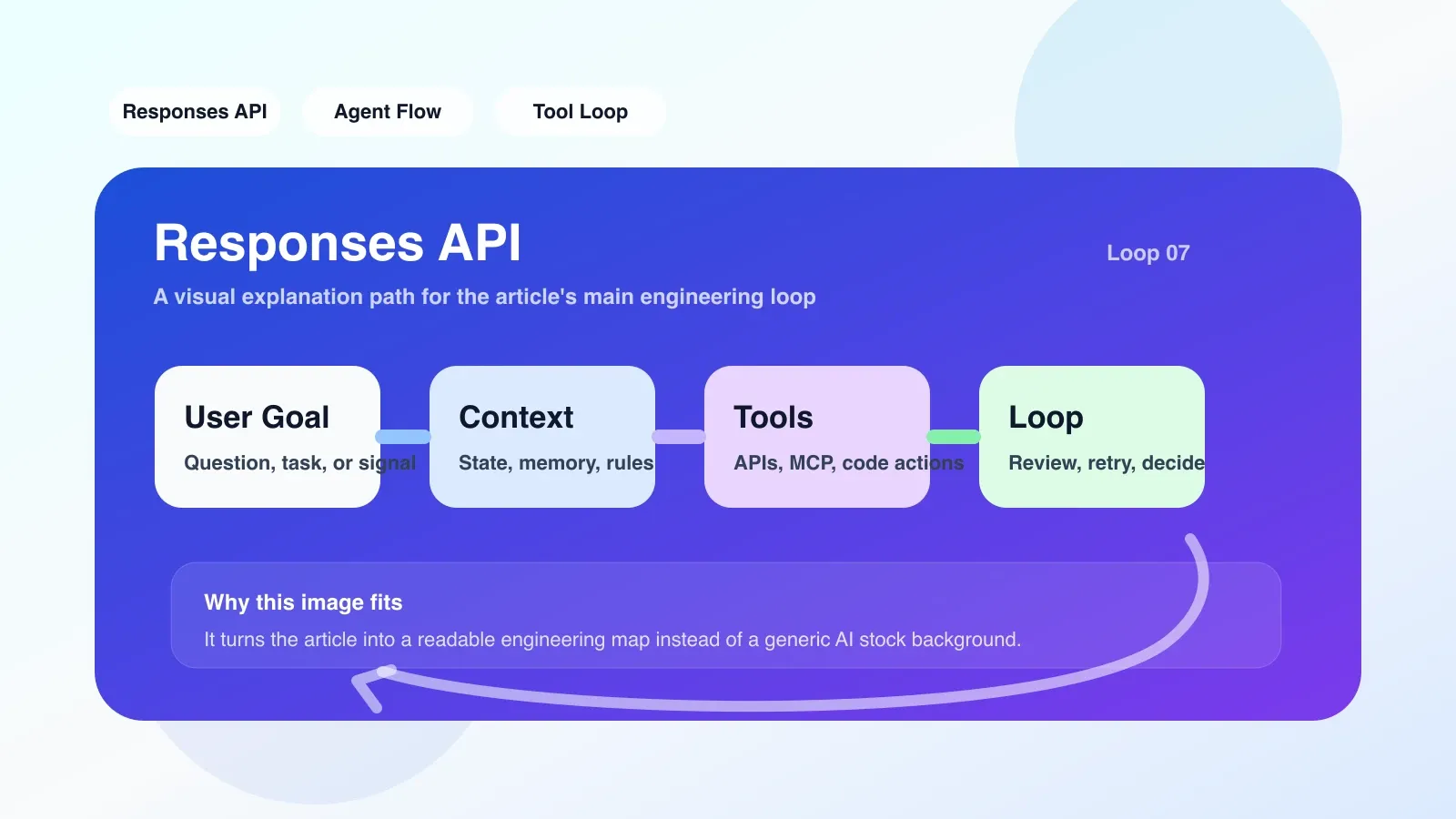
Responses API vs Loop Engineering: Should I use the built-in proxy capability or write my own loop control?
For most developers, this question can be answered directly:
- If your goal is to make multiple rounds of calls, tool execution, and state continuation faster, give priority to Responses API.
- If your goal is complete control over every step of state machines, retry strategies, tool routing, auditing, and failure recovery, give Loop Engineering priority.
- In the end, many real projects do not choose one of the two, but use the Responses API to be responsible for model-side reasoning and tool orchestration, and use custom loops to be responsible for business-side constraints and governance**.
This is not a simple comparison between "new API" and "old writing method", but the different positions of the two engineering control planes: one gives more loop capabilities to the model interface layer, and the other leaves loop logic in the application layer.
Concept explanation
What is Responses API?
Responses API can be understood as a type of model interaction interface that is more suitable for agent scenarios. It's not just a one-time input and output, but revolves around:
- Multiple rounds of responses
- Tool call
- Contextual continuation
- Structured output
- An interaction method closer to agent workflow
to organize requests and responses.
Its core value is not "smarter models" but rather reducing the burden of your own handwritten conversation state, tool backfilling, and multi-step orchestration.
What is Loop Engineering?
Loop Engineering is not an official API name, but an engineering method: **You write a loop yourself at the application layer, and let the model, tools, status and business rules advance repeatedly in this loop until the task is completed or the exit condition is triggered. **
A typical loop will contain:
- Read current task status
- Call the model to generate the next action
- Determine whether to call the tool
- Execute the tool and write back the results
- Check whether it is completed, failed or exceeded the limit
- Continue to next round or abort
It is essentially a way of "implementing the agent runtime yourself".
What is the real difference between the two?
The real difference is not "whether you can make tool calls", but rather:
- Which layer is the control right: Responses API is biased toward the interface layer; Loop Engineering is biased toward the application layer.
- Who bears the complexity: Responses API helps you eat part of the interaction complexity; Loop Engineering bears all the explicit orchestration yourself.
- Governability and Auditability: Loop Engineering is generally stronger because every step is in your code.
- Delivery Speed: Responses API is generally faster.
Implementation principle
How the Responses API works
In the Responses API path, applications typically do the following:
- Submit user input, system constraints, and available tool definitions.
- The model decides whether to answer directly or request a tool.
- Apply the execution tool and return the tool results.
- The model continues to reason based on the new results until the final output is generated.
The key point of this type of pattern is: The loop still exists, but the interface has abstracted a lot of the details of multiple rounds of interaction for you. What you wrote is not a complete agent runtime, but more like "working with an existing runtime".
Suitable engineering benefits include:
- Less boilerplate code
- Make working prototypes faster
- Easier to connect tool calls, structured responses, and multiple rounds of reasoning
But the price is also clear:
- Some underlying processes are not as transparent as if you write the loop yourself
- When encountering special business rules, it may still be necessary to wrap another layer of control logic in the outer layer
- If the team has high requirements for performing link audits, interface layer abstraction alone may not be enough
How Loop Engineering works
In the Loop Engineering path, the application decides what happens each round. Common structures look like this:
- Initialize task context, budget, round limit and exit conditions.
- Call the model and ask it to propose the next action based on the current state.
- The application verifies whether this action is allowed to be executed.
- If the action is a tool call, it is executed according to your own permission model.
- Write the results to the state store.
- Choose to continue, roll back, retry, upgrade to manual processing or terminate based on the results.
The advantage of this approach is not that it's "more advanced" but that every decision point is programmable. You have very fine-grained control over:
- Tool whitelist
- call budget
- Error retry strategy
- Manual approval node
- State persistence
- Concurrent or serial execution strategies
- Audit log format
But you'll also incur significant costs:
- Lots of programming code
- Wider test coverage
- Prone to endless loops, state pollution, and retry storms
- First version delivery is usually slower
Responses API vs Loop Engineering How to choose?
Preference is given to Responses API
More suitable for the following needs:
- You need to launch an AI function with tool calls as soon as possible
- The workflow is relatively short and the number of steps is controllable
- The main goal is to integrate model capabilities into products, rather than building a self-built agent runtime
- Your team’s requirements for transparency in underlying scheduling are not that extreme.
- You want to focus on prompt, tool schema, and response handling as the main development focus
Typical example:
- Code explanation, document Q&A, single task assistant
- Limited multi-step R&D auxiliary process
- Initial verification of whether the agent use case is worth continuing to invest in
Prefer Loop Engineering
More suitable for the following needs:
- The task is long, the steps are not fixed, and may span multiple systems
- Each round of state migration must be clearly controlled
- Requires strong auditing, strong authority, and strong budget control
- After calling the tool, you need to enter complex business judgments instead of directly returning to the model to continue reasoning.
- You already know this process is here to stay and is worth the engineering cost of governance capabilities
Typical example:
- Multi-system automation agent within the enterprise
- AI operation and maintenance process with approval, rollback, and alarm
- Production systems with high requirements on error recovery and responsibility tracking
A practical judgment standard
If you are discussing "how to get the function running as quickly as possible", most of the time you start with the Responses API.
If you are discussing "how to ensure that it is reliable, controllable and can pass audits in the long term", most of the time you have to rely on Loop Engineering.
If you already need to write these things:
- Custom state machine
- Multi-layer retry strategy
- Manual intervention node
- Task budget and timeout arbitration
- Tool permission classification
- Persistence task recovery
Then you have actually entered the scope of Loop Engineering, and there is no need to pretend to just "simply connect an API".
Applicable boundaries
Responses API is not suitable for solving situations
In the following scenarios, the Responses API alone is often not enough:
- The execution order of each step needs to be strictly determined, and the model cannot freely decide too much
- Tool calls must be approved by a complex rules engine
- The task may run for a long time and must be resumed from breakpoints
- Fine-grained auditing and playback of each action is required
- You need to stably reproduce a certain execution path instead of accepting model-driven flexible decision-making
A more reasonable approach at this time is: **Use the Responses API as an inference component instead of treating it as a complete runtime. **
Situations that Loop Engineering is not suitable to solve
In the following scenarios, writing your own loop is easy to over-design:
- Just make an AI assistant in a few steps
- The demand is still in the exploratory stage, and the process will change frequently.
- The team does not have enough time to complete the infrastructure for state machines, logs, and tests
- The business value has not yet been verified, but a large amount of orchestration costs have been invested in advance
At this time, if you force yourself to go to Loop Engineering, the most common problem is not that you can't do it technically, but that the ROI is very poor.
The most easily misjudged point
Many teams directly equate "I need an agent" with "I want to write my own loop." This is usually too early.
What you should really ask is:
- Do I need agent behavior or agent infrastructure?
- Is my current bottleneck capacity access or process governance?
If it's just the former, the Responses API is often enough.
Case or practice points
Scenario 1: AI coding assistant prototype
Suppose you are making a development aid and the goal is to:
- Read requirement description
- Check code repository information
- Call the search tool
- Output modification suggestions or task breakdown
The reason why Responses API is preferred in this type of scenario is very straightforward:
- The task chain is not particularly long
- Limited variety of tools
- The focus is on "making the model know how to use tools" rather than "building a complete agent platform"
- You need to verify whether the user is really willing to use it
Practical focus:
- Tool definitions should be few and clear to avoid giving the model too many similar tools
- The output structure should be fixed to reduce post-processing ambiguity -Set round or budget caps to prevent meaningless iterations
Scenario 2: Multi-system task agent within the enterprise
Assume that the task spans the work order system, code warehouse, CI, alarm platform and approval system, and if any step fails, it will be rolled back or upgraded manually.
Relying solely on the Responses API at this point often seems shaky, because the real complexity is not "what the model says" but:
- Which steps are allowed to be executed automatically -Which step requires manual approval?
- How to recover after failure
- How to prove that the system has not exceeded its authority?
It is more suitable to use Loop Engineering as the main control layer here, and then decide whether to connect the Responses API as one of the inference nodes.
Practical focus:
- Clarify the status flow, do not put the business status only in the prompt
- Tool execution and model inference logs are recorded separately
- All exit conditions must be explicitly coded rather than relying on the model to "stop itself"
Scenario 3: Compromise plan
Many teams end up in the middle:
- Handle multiple rounds of inference and tool intent generation with the Responses API
- Use application layer loops to handle budgets, permissions, approvals, persistence and failure recovery
This is usually a more stable combination, because it separates "the parts that the model is good at" and "the parts that the system must strictly control".
If you can only remember one piece of practical advice, it would be this: **Don't hand over business governance responsibilities entirely to the model interface, and don't rewrite all the runtime yourself from the beginning. **
The easiest trap to step into
Mistaking interface capabilities for system capabilities
The Responses API can reduce orchestration work, but it does not mean it comes naturally:
- Audit completeness
- Permission isolation
- Long task recovery
- Business-level idempotent guarantee
These still need to be completed at the system level.
Write your own loop but there is no exit mechanism
The most common accidents at Loop Engineering are:
- infinite loop
- Retries out of control
- Continuous calls of tools lead to out-of-control costs
- Status writeback is inconsistent
Without round caps, budget caps, error thresholds, and manual takeover points, loops can easily go from "controllable orchestration" to "difficult to govern automated sources of risk."
Premature optimization of the architecture
Many projects invest a lot of time in writing agent runtime, state storage and complex scheduling before verifying the user value. The result is not that the architecture is wrong, but that no one uses it at all.
A more realistic approach is:
- First use the Responses API to verify whether the task closed loop is established.
- Then extract the high-risk, high-frequency, and long-link parts to a custom loop
What is the backup plan in case of failure?
If the Responses API route fails, there are three common fallback options:
- Narrow the task boundaries and change the open agent into a fixed process that can be completed in a few steps.
- Retain the model generation capability, but migrate tool scheduling, approval and status management back to the application layer.
- Change high-risk actions to "suggestion mode", which outputs operation suggestions first and does not directly execute them automatically.
If the Loop Engineering route fails, the common fallbacks are clear:
- Cut off overly complex state machines and keep only the critical paths.
- Handle the low-risk, multi-round reasoning part to the Responses API.
- Change fully automatic to semi-automatic, add manual confirmation nodes, and ensure stability first.
Most importantly, don't just continue calling prompt after failure. Many problems are not prompt problems at all, but:
- Task boundaries are too large
- Tool design is too messy
- The permission model is unclear
- Incomplete status management
Conclusion
Responses API is more like an interface layer capability that accelerates the implementation of agent functions, and Loop Engineering is more like an engineering control method for self-built agent runtime.
If you value speed and want to make multiple rounds of tool calls first, start with the Responses API first.
If you value governance, auditing, recovery, and long-term controllability, prioritize Loop Engineering.
For most teams that are serious about producing production systems, the most practical answer is usually not to choose one of the two, but to:
- First use the Responses API to get through the value closed loop
- Then use Loop Engineering to take over the parts that must be strictly controlled
Next step
If you want to truly transition from an ordinary developer to agent engineering practice, the key is not to memorize a few new terms, but to systematically master these issues:
- How to divide the work between the model interface layer and the application control layer
- Which layer should context, tool, loop, and MCP be placed on?
- When should you use ready-made capabilities and when must you implement the runtime yourself?
Continuing to read more systematic original paid articles and advanced AI programming courses will be more effective than repeatedly spinning around in scattered concepts.
No comments yet. Be the first to share your thoughts.