
Complete Process
W3C Working Group promotes Web technology standardization following a series of steps, called W3C Technical Report Development Process.
[caption id="attachment_1451" align="alignnone" width="466"]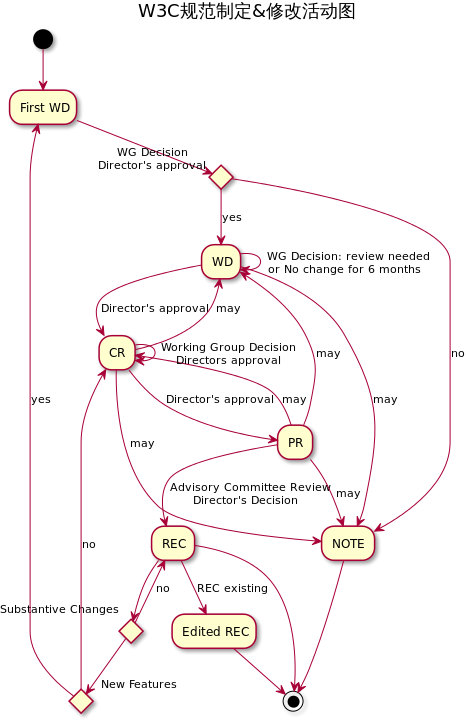 w3c process flow[/caption]
Divided into 2 parts: standardization process and subsequent modification process, see details below.
Standardization Process
Main process as follows:
WD -> CR -> PR -> REC
1     2     3     4
Starting from the first WD (Working Draft), through CR (Candidate Recommendation), PR (Proposed Recommendation), finally becoming REC (Recommendation). The 3 stages before REC all have opportunities to regret:
-
WD, CR can be repeatedly confirmed
-
CR can roll back to WD
-
PR itself has no repeated confirmation, but can roll back to CR and WD
After becoming REC, there are two possible state changes:
-
Republish as Edited Recommendation
-
Be rescinded, becoming Rescinded Recommendation
Additionally, W3C can terminate the entire process at any time.
The specific standardization process is:
-
Publish First Public Working Draft
-
[Optional] Publish several revised Public Working Drafts
-
Publish Candidate Recommendation
-
Publish Proposed Recommendation
-
Publish W3C Recommendation
-
[Optional] Publish Edited Recommendation
From WD to REC, maturity increases, the Director can refuse to advance to higher maturity stages, or choose to roll back to lower maturity stages.
Working Draft (WD)
Working Draft is a document published by W3C for community review, including W3C members, public, and other technical organizations.
Generally, working drafts are intended to advance to Recommendation, the working group's expectations are in the working draft's document status section. Any working draft not intended or no longer intended to advance to Recommendation should publish Working Group Note. Working drafts do not necessarily represent the consensus of the working group, nor does it imply any endorsement by W3C or its members beyond working in the general technical field.
Candidate Recommendation (CR)
Candidate Recommendation is a document that meets the working group's technical requirements and has undergone extensive review.
W3C publishes Candidate Recommendation for 4 purposes:
-
Indicate to the community that final review should be done
-
Collect implementation experience
-
Advisory Committee begins formal review, they may recommend publishing the document as W3C Recommendation, roll back to working group for further revision, or abandon it
-
Provide opportunity to exclude according to W3C Patent Policy. Note: Candidate Recommendation in this process corresponds to Last Call Working Draft in Patent Policy
Note: Candidate Recommendation is expected to be accepted as Recommendation, if not, should note why expectations changed at such a late stage.
Proposed Recommendation
Proposed Recommendation is a document that has been accepted by W3C Director as meeting quality standards (quality sufficient to be W3C Recommendation). This stage establishes final deadline for Advisory Committee to review from Candidate Recommendation. Substantive modifications to Proposed Recommendation are prohibited, unless publishing new Working Draft or Candidate Recommendation.
W3C Recommendation (REC)
W3C Recommendation is a specification or requirement that has achieved broad consensus and has been approved by W3C members and Director. W3C recommends its Recommendations be widely used as Web standards, W3C royalty-free intellectual property licenses granted according to W3C Patent Policy apply to W3C Recommendations.
Obsolete Recommendation
Obsolete Recommendation is a specification that W3C believes does not have sufficient market relevance to support continuing to recommend the community to implement, rather than saying there are fundamental issues requiring rescinding the Recommendation. Obsolete Recommendations may gain sufficient market share, at which time W3C will restore it to Recommendation status. Obsolete Recommendations have the same status as Recommendations with royalty-free intellectual property licenses granted by W3C according to Patent Policy.
Rescinded Recommendation
Rescinded Recommendation is a complete Recommendation that W3C no longer endorses, believing it impossible to restore to Recommendation status.
Working Group Note, Interest Group Note (NOTE)
Working Group Note or Interest Group Note is published by chartered Working Group or Interest Group, to provide stable reference for useful documents not intended as formal standards, or to record abandoned work that did not form Recommendation.
Working Groups and Interest Groups may provide Editor's draft, Editor's drafts have no official status, do not represent consensus of Working Group or Interest Group, nor can their content be approved by W3C in any way.
REC Modification Process
After Recommendation is published, modifications may be needed (such as errata, or major changes), modification process must be followed:
// Substantive changes (major changes)
Need to add new features -> Publish first WD, start the entire process from beginning
No new features added -> Return to CR stage after Director approval

// Non-substantive changes (minor changes)
No changes after Director approval
Errata Management
Because error tracking for Recommendations is a continuous concern for working groups, working group charter scope generally allows errata work after Recommendation publication.
Working groups must maintain records of errors reported by readers and implementers, such error reports must be processed no less frequently than quarterly, Recommendation readers must be able to easily access errata corresponding to specific Recommendations.
Working groups decide how to record errata, best practice is a document determinable from Recommendation text content, clearly indicating errata and any proposed corrections, or other methods containing various forms of errata pages, such as automatically generated from database.
Errata are resolved by informative "proposed" corrections given by working groups. After the Recommendation revision process described in the next subsection, corrections become part of the Recommendation.
Recommendation Revision
Working groups can request republishing Recommendations, otherwise W3C may republish Recommendations to make corrections without making any changes to specification text.
Editorial modifications to Recommendations do not require technical review of proposed changes, if publishing resolution has no opposing votes, working groups can request publishing a Recommendation, otherwise W3C may publish a Recommendation to make such changes without going through earlier maturity levels, such publications are called Edited Recommendation.
For Recommendations with substantive changes but no new features added, or if there are votes opposing direct publication of amendments as Recommendations, working groups can request publishing Candidate Recommendation, without going through earlier maturity levels.
In the latter two cases, the resulting Recommendation is called Edited Recommendation.
When requesting publication of Edited Recommendation mentioned in previous section, in addition to meeting relevant maturity level requirements, working groups must:
-
Must indicate document changes have undergone extensive review
-
Should resolve all recorded errata
For changes that introduce new features, W3C must start from new First Working Draft, follow the complete process of advancing technical reports to Recommendations.
No comments yet. Be the first to share your thoughts.