
What is Codex
If explained in just one sentence, Codex is an AI coding agent oriented to software development tasks: it receives the target, reads the code and context, analyzes, modifies, runs, and verifies it in a restricted environment, and then feeds the results back to the developer.
This definition is more accurate than "a model that can write code", because the most common misjudgment point for many people when they first come into contact with Codex is to regard it as a smarter code completion tool. In fact, Codex is closer to an execution unit that works in a closed loop around tasks: it not only generates a few lines of code, but also tries to understand the warehouse structure, identify dependencies, decide where to read first, when to change, when to stop, and how to fall back to manual judgment after failure.
What is the core value of Codex?
For developers, Codex is important not because it automates "writing code", but because it compresses part of the repetitive engineering cognitive chain. A typical chain usually includes:
- Understand requirements and constraints.
- Search for relevant documents and existing implementations.
- Infer modification points and associated impacts.
- Generate changes.
- Run the verification.
- Report results and risks.
Traditional code assistants tend to only cover step 4, plus a little bit of step 2 at most. The value of Codex lies in stringing together steps 1 to 6 as much as possible to form "contextual task execution" rather than "code snippet generation without the warehouse."
This is why it appears in discussions such as agent, context, loop, and tool use. It does not represent a button, but a way of working in AI coding: allowing the model to execute a short section of the real engineering process under clear constraints.
How does Codex work?
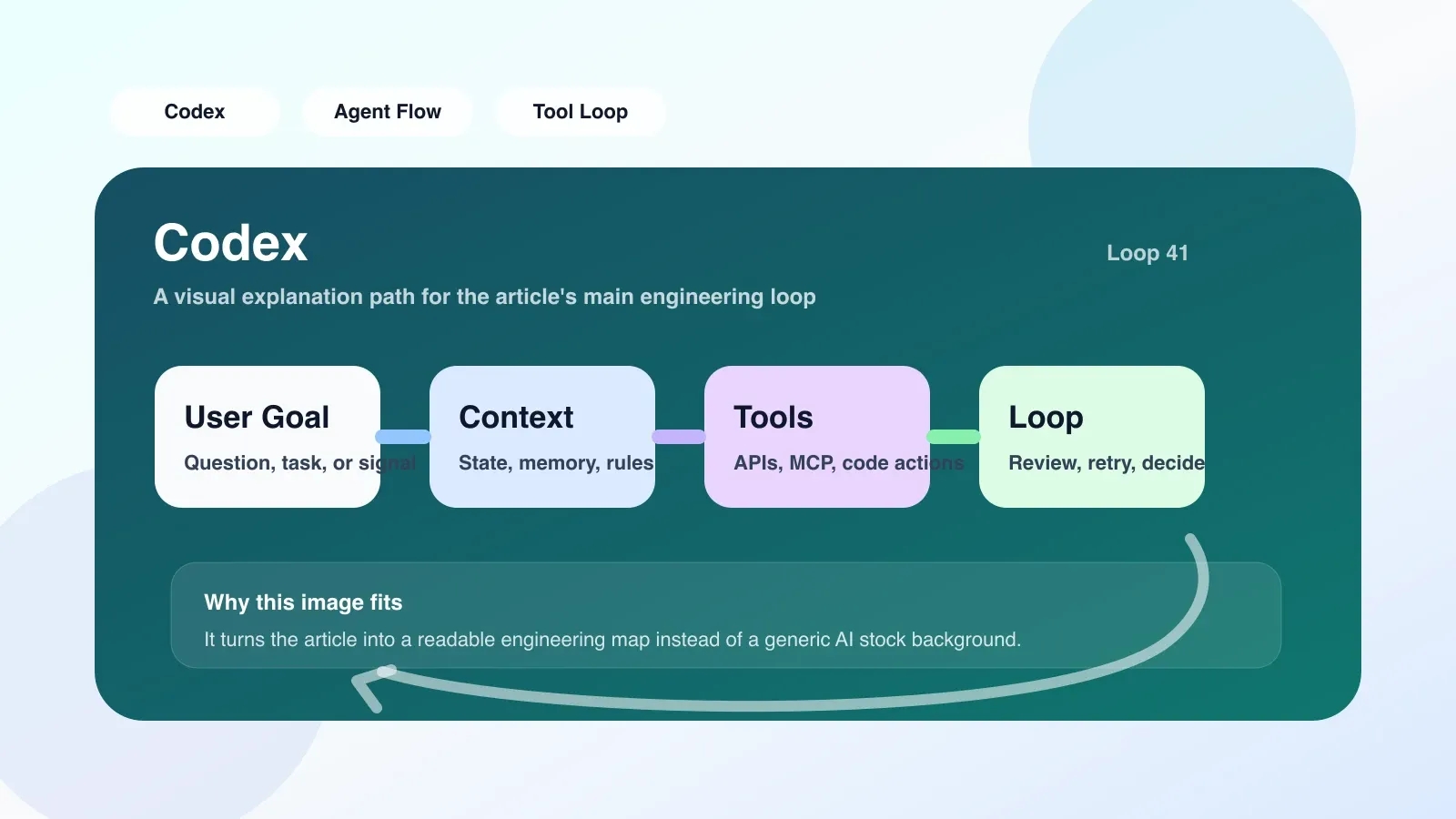
From the perspective of implementation principles, Codex can be understood as a four-layer combination rather than a single model.
1. Target layer: Turn natural language tasks into executable goals
The input given by the developer is usually not a complete specification, but a task description, such as "Fix the timeout problem of this interface" or "Generate a publishable SEO content package for this article." The first thing Codex needs to do is not to write the code immediately, but to convert the task into an operation goal:
- Which contexts to read.
- Which documents may be relevant.
- Whether it is necessary to run command verification.
- What are the success criteria.
- Which limits cannot be touched.
If this layer is misunderstood, the faster the subsequent execution, the more dangerous the result is usually.
2. Context layer: reading warehouse, rules and operating environment
The performance of Codex is highly dependent on context, rather than solely on model parameters. Valid contexts typically include:
- Current code repository and directory structure.
- Project conventions, such as testing methods, naming conventions, and design systems.
- Environmental constraints, such as read-only directories, prohibiting networking, and not destroying existing changes.
- Task-level instructions, such as research first and then execute, JSON must be output, and failure boundaries must be covered.
So, when asking "what is Codex", a more accurate answer is: it is a combination of "model + tool + warehouse context + operational constraints". Without these constraints and only talking about model capabilities, the explanation will be distorted.
3. Execution layer: Complete search, editing, and verification through tools
What really makes Codex feel like an "agent" is that it forms a chain of actions around the tool, rather than remaining in a text conversation. Common actions include:
- Search files and keywords.
- Read code or documentation.
- Edit target files.
- Run tests, builds or static checks.
- Compare the results and decide whether to continue.
This is very different from ordinary chat code Q&A. The latter outputs suggestions, the former attempts to advance the task.
4. Loop layer: continue, stop or hand over labor based on the results
The mature way to use Codex is not to let it execute infinitely, but to let it work in a limited loop:
- If the context is sufficient, continue execution.
- Stop and report if you find conflicts, missing permissions, failed tests, or ambiguous requirements.
- Output auditable results if the results have reached the target.
This step determines whether it will be more like an engineering assistant or more like a high-risk automated script. A good workflow must allow it to fail and make failure visible.
What problems is Codex suitable for solving?
Codex is best suited for tasks that have clear goals, are locally verifiable, and the context is readable.
Typical applicable scenarios include:
- Locate a relatively clear bug in an existing repository.
- Add tests, documents, and types to existing functions.
- Perform constrained content production tasks such as generating SEO content packages per fixed schema.
- Do small-scale refactoring, such as unifying naming, splitting a function, and completing error handling.
- Help developers quickly sort out unfamiliar modules and output impact areas and modification suggestions.
These tasks have one thing in common: success and failure are relatively easy to judge. For example, whether the test passes, whether the JSON conforms to the schema, whether the page copy covers necessary issues, and whether the changes fall within the limited file.
What Codex is not suitable for
This is where many teams are most likely to get into trouble. Codex is not suitable for all development work, and is particularly unsuitable for the following types of tasks:
1. The requirements themselves have not been clearly defined.
If even the goal is still wavering, such as "make a more advanced architecture" or "help me optimize the experience", Codex can easily produce high efficiency in the wrong direction. It will fill in the ambiguity, but what it fills in is a hypothesis, not necessarily the result you want.
2. Requires a lot of implicit business knowledge
When key judgments are hidden in verbal agreements, historical decisions, team politics, or grayscale rules, the model will complete them without seeing them. Completion does not mean understanding, but the risk is higher.
3. The cost of failure is extremely high and there is no protection network
Directly change the payment link, production database script, permission control, and compliance logic. Without strong review, testing, and rollback mechanisms, Codex should not be put in the first place of execution. It can assist analysis, but should not be implemented automatically by default.
4. The result cannot be quickly verified
If after a task is completed, the team cannot tell whether it is correct or not, then it will be difficult for Codex to work stably. Because the agent relies most on the feedback loop, without verification, it can only rely on "looking right".
A more practical understanding: Codex does not write the code for you, but advances a project loop for you.
When many people ask "what is Codex", they are actually asking two questions:
- Does it go further than code completion?
- Can it replace engineers?
To the first question, the answer is usually yes. Because its value lies in task advancement, not just token-level completion.
To the second question, the answer is usually no. At least in real projects, Codex is more like an execution agent that can be constrained, reviewed, and interrupted, rather than someone who can independently assume product and engineering responsibilities.
The really effective usage is to put it into your existing engineering system, for example:
- Give it a clear scope first, and then let it execute.
- Only authorize it to modify limited files or directories.
- Run a test first before deciding whether to accept the changes.
- Ask it to stop and explain why when it encounters a conflict. -Leave high-risk decisions to people.
Practical points: How to use Codex correctly
If this is the first time you put Codex into the development process, the following approach is more reliable than "just give a big request".
Define the task boundaries first
A good mission description usually contains four things:
- Goal: What to accomplish.
- Scope: Where changes are allowed and where changes are not allowed.
- Acceptance: How to count completion.
- Restrictions: hard constraints such as not being able to connect to the Internet, not being able to touch the database, not being able to change the public interface.
For example, "Fix the FAQ rendering error of the article_detail page, only allow changes to the rendering layer file, retain the existing schema, and output JSON that can be directly published." This kind of task is much more stable than "optimize the article page."
Give the minimum necessary context
Codex doesn't require you to re-explain the entire system, but it does require enough key information to reduce guesswork. The most useful contexts include:
- The file path related to the current function.
- The output format that must be adhered to.
- Business rules that cannot be broken.
- Known failure cases or common misunderstandings.
The goal of this step is not "the more information, the better", but "make it less likely to make wrong assumptions."
Let verification precede expansion
Many failures are not due to errors in the first step, but because once the model starts to be produced, the scope of changes will continue to expand. A safer way is to change the rhythm to:
- Position first.
- Make minimal modifications.
- Verify now.
- Stop explaining if it doesn’t pass.
This is much safer than letting it "optimize all related problems" at once.
Treat failure as design input
When using Codex, don’t just ask “what it can do”, but also plan in advance “when it must stop”. Common stopping conditions include:
- No clearly related document found.
- Requires speculative changes across multiple subsystems.
- Tests fail to run or have conflicting results.
- The existing workspace already has uncommitted changes by users and may conflict.
- Task requirements conflict with warehouse rules.
When these conditions arise, the best action is not to continue trying, but to return to manual judgment.
Several scenarios where failure is most likely to occur
Treat Codex as a general contractor
You give it a broad goal and expect it to split its requirements, design, implement, and launch it by itself. This expectation itself is unrealistic. What Codex is good at is constrained advancement, not taking on all the responsibilities in vague tasks for you.
Insufficient context but requires one success
If there are no warehouse rules, no output requirements, and no acceptance criteria, but the results are required to be "one step at a time", failure does not mean that the model is incompetent, it only means that the input method is not suitable for agent execution.
If you see that you can run, just accept it.
Being able to run does not mean that it is maintainable, and being able to pass a test does not mean that no structural problems have been introduced. Every change produced by Codex still needs to be reviewed based on engineering standards:
- Whether it conforms to the existing architecture.
- Whether the coupling is expanded.
- Whether the real root cause is bypassed. -Whether there is patch logic left that will be more difficult to repair in the future.
What is the backup plan in case of failure?
When Codex fails to work, the most practical backup plan is usually not to "change to a stronger model and continue to try hard", but to return to a more controllable way of working.
It can be processed in this order:
- Break large tasks into smaller, verifiable subtasks.
- Change it to only do reading, positioning and risk analysis without direct modification.
- Make key design decisions manually and then return partial execution to Codex.
- Switch to traditional engineering processes for high-risk parts: manual coding, code review, testing, and grayscale release.
In other words, the best alternative when Codex fails is often not "more automatic" but "clearer and more controlled."
Actual judgment criteria for developers
If you're evaluating whether to incorporate Codex into your workflow, here are four questions you can ask yourself:
- Are the success criteria for this task clear?
- Can most of the relevant context be read?
- Are the consequences of failure controllable?
- Do I have a verification and review mechanism?
If the answer to more than two of the four questions is no, it should not be used as the main execution path. Make up the process first, then talk about agency.
What to learn next
When you already understand the core of "what is Codex", you don't have to stay at the conceptual level. What really widens the gap is the second step: putting Codex into the agent engineering workflow and learning to design context, tools, loops, stop conditions and acceptance criteria.
If your goal is not to try it out occasionally, but to move from an ordinary developer to someone who can stably build an AI coding workflow, you should systematically learn these topics next:
- How to write the correct agent task description instead of just writing prompt words.
- How to control context to prevent the model from going further and further on wrong assumptions.
- How to connect MCP, tool calling and execution loops into the real development process.
- How to design failure boundaries, review points, and manual takeover mechanisms.
This step is the watershed from "being able to use AI" to "being able to do Agent engineering".
No comments yet. Be the first to share your thoughts.