
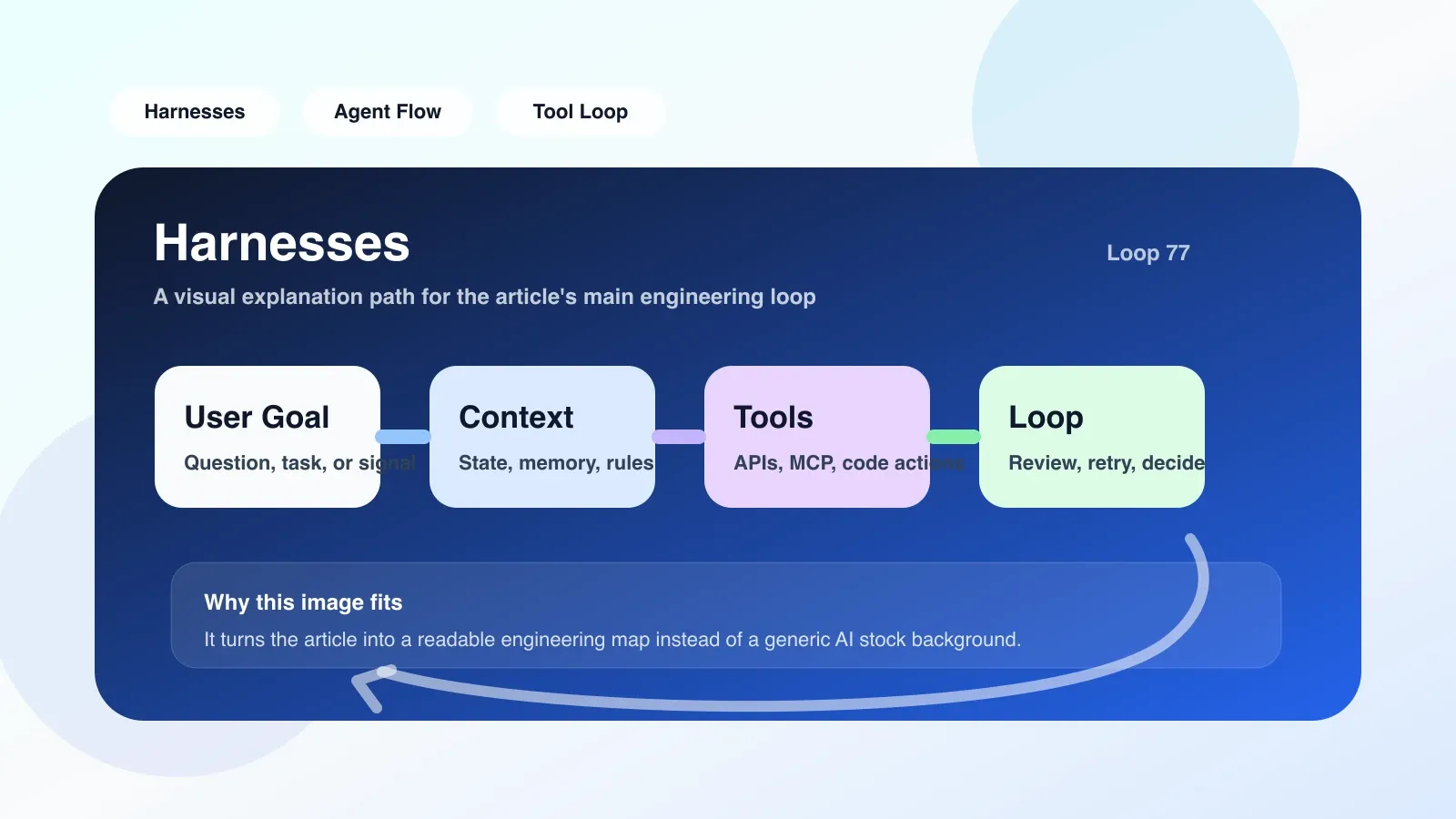
What Is Harnesses: In AI engineering, what exactly are Harnesses?
If you see Harnesses in AI coding, agents, eval or automation workflows, in most cases it does not refer to a mysterious new concept, but a set of "jig-style frameworks" for execution, testing, comparison and regression verification tasks.
To put it more bluntly:
**The role of Harnesses is to turn a process that was originally tried manually into an engineered loop that can be run repeatedly, record results, compare versions, and detect degradation. **
In different teams, this word may be called:
- test harness -evaluation harness
- benchmark harness
- agent harness
- workflow harness
The name will change, but the core remains the same: **Cover a reproducible shell for the model, agent or workflow. **
Concept explanation: What problem are Harnesses solving?
Many AI workflows can "run through" at the beginning, but it is difficult to "stabilize" them. Common symptoms include:
- I changed one sentence of prompt, but the quality of the results fluctuated.
- Once the tool call chain becomes long, errors will be difficult to reproduce
- After changing the model version, the surface is usable, but the key tasks are silently degraded
- Team members manually tested each other, and the conclusions did not agree with each other.
Harnesses' solution is not to "make the model smarter", but to make the verification process more reliable.
A minimally understandable definition is:
Harnesses is an engineering operation framework that connects input samples, execution processes, result collection, scoring standards and version comparisons.
So why it matters, not because the terminology is new, but because it allows teams to answer practical questions like:
- After changing the prompt this time, has it changed for the better?
- What is the success rate of this Agent on 20 real tasks?
- Are there any regressions before launch?
- Is the failure a model issue, a context issue, or a toolchain issue?
Implementation principle: What parts are Harnesses usually composed of?
Whether you're using a custom script, a testing framework, or a more complete platform, Harnesses generally consist of 5 core layers.
1. Use case collection
This is the basic input of Harnesses, that is, what tasks you want to use to verify the system.
Common forms include:
- Sample Q&A
- Code fix tasks
- Tool call tasks
- Multiple rounds of dialogue scenes
- Structured output tasks with standard answers
Without this layer, the so-called evaluation often degenerates into "trying two random examples." That's not Harnesses, just a temporary demo.
2. Executor
The executor is responsible for actually running each use case, for example:
- Assemble prompt template and input parameters
- Call model or agent
- Trigger tool calls when needed
- Inject system prompt words, context windows or memory layers
- Record the input and output of each step
The focus of this layer is not "can be called", but that each call must be consistent and traceable.
3. Observation and logs
If Harnesses only returned a final answer, the value would be limited. Really useful Harnesses record:
- raw input
- prompt or message sequence
- Model version
- Tool call track
- Output results
- error message
- Delay, cost, token consumption
This way when the results get worse, you can pinpoint which layer the problem is.
4. Scoring and Judgment
Harnesses don’t just answer “done,” but also answer “how was the run.”
There are three common categories of scoring methods:
- Rule determination: for example, whether the JSON is legal, whether the fields are complete, and whether the test passes
- Compare answers: e.g. compare key fields or behaviors with standard output
- Manual or semi-automated review: suitable for open-ended tasks, but more expensive
This step determines whether Harnesses can really be used as a basis for judgment before going online. If the scoring criteria are vague, the entire system will be distorted.
5. Comparison and regression mechanism
This is where the real value in engineering comes from.
You need more than just a single score, but:
- Comparison of old and new prompts
- Comparison of old and new model versions
- Comparison of old and new tool chains
- Whether a certain change introduces regression
So Harnesses is essentially a continuous comparison system, not a one-time script.
Why it matters more now
In traditional software, code logic is mostly deterministic; but in AI workflow, what you face is:
- Model output is probabilistic
- prompt adjustments amplify behavior changes
- The longer the tool call chain, the more failure points there are -Context injection method will directly change the result
This means that "manual testing" can easily lead to false judgments. It seems to work today, but it will fail tomorrow if you change the input or model version.
The value of Harnesses lies in converging this instability into an observable, comparable, and regressable process.
Case or practice points: How to use it in AI coding / Agent workflow
Let's say you're making a code assistant that:
- Receive requirements
- Read warehouse context
- Generate modification plan
- Call tools to read and write files
- Output final changes
Without Harnesses, teams typically verify this:
- Developers choose 2 to 3 examples to try out
- Continue iterating if it looks "almost"
- After going online, it was discovered that some warehouse structures were obviously ineffective.
A safer approach is to build lightweight Harnesses:
- Prepare a batch of representative tasks.
- Define minimum success criteria for each task.
- Fixed model, context assembly method and tool permissions.
- Execute in batches after each change.
- Record the success rate, failure types, time taken and cost.
- Attribute failure cases instead of just looking at average scores.
In this scenario, Harnesses can easily bring three direct benefits:
- You can know whether the changes actually improved the task completion rate
- You can identify which types of warehouses or tasks the failures are concentrated in
- You can spot significant regressions before they go live
In practice, the most worthwhile thing to do first is not "big and comprehensive", but "representative"
Many teams want to cover all scenarios when doing Harnesses for the first time. As a result, the maintenance cost of the data set is too high and it is quickly abandoned.
A more practical starting point is:
- Grab the most common 10 to 20 high-value tasks first
- Only 1 clear passing criterion is defined per task
- First divide the failure cases into several categories and then expand the sample
This is more effective than the empty pursuit of "comprehensive reviews."
Don’t just look at the average score, look at the failure structure
If 15 of the 20 tasks pass and 5 fail, the average success rate does not look bad; but if those 5 failures happen to occur in high-value scenarios such as "multi-hop tool chain", "long context" and "structured output", the system is actually still unstable.
So the correct pronunciation of Harnesses is usually not "total score", but:
- What types of tasks are failing?
- Which step is most often wrong?
- What kind of changes cause degradation?
- Whether there are high-risk long-tail scenarios
Applicable boundaries: Not all problems should be submitted to Harnesses
Harnesses are useful, but the earlier and the heavier, the better.
Suitable scenarios for use
- You already have recurring AI tasks
- You are comparing different prompts, models or toolchains
- You need regression verification before going online
- The team has more than one person, and the testing caliber needs to be unified
- The cost of failure is not low, you cannot rely solely on artificial feeling
Not suitable for scenes
- You are still exploring problem definition and do not have a stable task set.
- Each mission is highly customized, with almost no reused samples
- The team is small and just needs to quickly verify ideas for the time being.
- The scoring criteria completely rely on subjective judgment and are difficult to structure in the short term.
Common limitations
- Harnesses can only evaluate the tasks you put in, and cannot automatically represent the entire real-world distribution
- If the sample is too narrow, the score will be artificially high
- If the scoring rules are written too mechanically, the model may be "optimized for reviews" but not for real users
- If the observation layer is insufficient, it will be difficult to attribute failure.
In other words, Harnesses are a tool to reduce uncertainty, not to eliminate it.
The most likely place to fail
It’s not that many teams don’t know how to do Harnesses, but they will make it something that “looks very rigorous but actually has no decision-making value”. The most common pitfalls are:
1. Use cases are not derived from real tasks
If the sample is just to make up the quantity, the results will be difficult to guide product or engineering decisions. Harnesses must be as close to real input as possible, rather than idealized examples.
2. The scoring criteria are unclear
Criteria such as "feeling better" and "looking more natural" can exist during the discussion stage, but once it comes to Harnesses, at least some grounded judgments are needed.
3. Mistaking one-time scripts for Harnesses
Being able to run in batches does not mean it has verification value. There are no logs, no comparisons, and no stable scoring scripts. It is more like an experimental tool than an engineering Harnesses.
4. Only look at the pass rate, not the cost and delay
Some changes will indeed improve the success rate, but at the cost of skyrocketing token costs and significantly longer response times. For real business, this is not necessarily an improvement.
5. Failure classification is not processed
If you just say "failed" every time, the team will quickly lose direction. Failures must at least be distinguished as:
- Model understanding error
- Missing or contaminated context
- Tool call failed
- The output format is unqualified
- Multi-round status management failure
What is the backup plan in case of failure?
If you don't have what it takes to fully build Harnesses, there are usually three most pragmatic alternative routes.
Option 1: First create a lightweight manual evaluation set
Use 10 to 20 high-value real-life examples, prepare a minimum record list, and compare different prompts or model versions first. It's not as systematic as full Harnesses, but it's much better than just trying it out.
Option 2: Only make key node assertions
If your process is long, don’t do a full-link assessment yet. Make assertions on the most critical and error-prone nodes first, for example:
- Whether the output is legal JSON
- Whether the necessary tools are called correctly
- Whether the key field is hit
This establishes a first-tier quality threshold at lower cost.
Option 3: Change back to a narrower problem definition
If you find that your ratings are inconsistent, the reason may not be that Harnesses are not strong enough, but that the task definition is too broad. A more effective approach at this time is to narrow the tasks to:
- More fixed input structure
- More single target output -Shorter call link
Run a narrow scenario first and then expand it, rather than trying to cover all Agent capabilities from the beginning.
Direct conclusion to "what is Harnesses"
If you just want to grab a sentence:
**Harnesses is an engineering framework that allows AI workflows to be repeatedly executed, stably evaluated, continuously compared, and regressions discovered. **
It is suitable for teams that have entered the iterative stage and need to use data rather than feelings to make decisions; it is not suitable for the early exploration stage where task boundaries have not yet been stabilized.
If you are now moving from ordinary development to AI engineering, the real value of understanding Harnesses lies not in memorizing term definitions, but in learning to connect prompt, context, tool use, loop and evaluation mechanism into a closed loop. This is the watershed between Agent engineering capabilities and ordinary "API tuning".
Next step
If you already understand what Harnesses are, the next most valuable action is not to continue searching for the concept, but to put it back into the complete Agent project stack to see:
- How it works with context management
- How it supports MCP or tool call verification
- How does it enter the regression system of multi-step loop?
- How it helps AI coding workflow stabilize iteration
It is more effective to systematically supplement these capabilities than to continue to pursue hot spots in a scattered way.
No comments yet. Be the first to share your thoughts.